
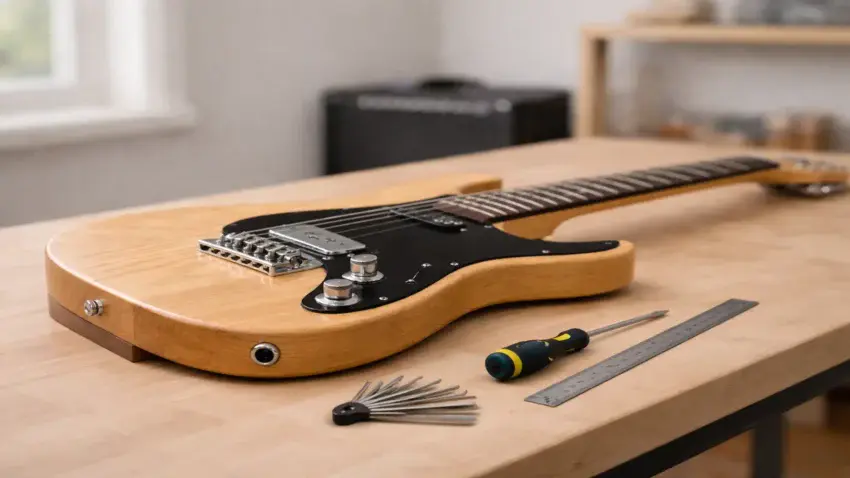
Not every setup issue is solved by turning a screw.
After neck relief, action, and intonation are set,
most remaining problems fall into one of three categories:
-
A small adjustment that needs patience
-
A tool-related limitation
-
A problem that shouldn’t be forced
This guide explains which tools are actually used during electric guitar setup,
how to recognize common setup problems, and — most importantly —
when to stop adjusting and reassess.
Good setups aren’t about having more tools.
They’re about knowing what to adjust, what to leave alone, and what to check next.
This guide is part of the complete Electric Guitar Neck & Setup Guide,
which walks through the full setup process in the correct order —
from neck relief and action to intonation and long-term playability.
Setup Tools: What They’re Actually Used For
Most electric guitar setup tasks rely on a small set of basic tools.
More tools don’t automatically mean better results —
especially if the underlying issue hasn’t been identified.
Common setup tools are used to:
-
Make small, controlled adjustments
-
Measure changes consistently
-
Avoid guessing or forcing parts
Tools should support decisions, not replace understanding.
Measuring vs Adjusting: Know the Difference
Some tools measure, while others adjust.
Measuring tools help you:
-
Check neck relief
-
Compare string height
-
Confirm changes after adjustments
Adjustment tools physically change the guitar:
-
Truss rod wrenches
-
Saddle screws
-
Bridge height adjustments
Confusing these roles often leads to over-adjusting a guitar
that was already close to correct.
Common Setup Problems (And What They Usually Mean)
Buzzing Strings
Buzz doesn’t always mean something is “wrong.”
It can be caused by:
-
Normal low action
-
Uneven frets
-
Inconsistent picking pressure
-
Environmental changes
Chasing buzz by raising action endlessly usually hides the real cause.
Dead Frets or Choking Notes
When notes die suddenly or choke during bends, the issue often involves:
-
Fret height inconsistencies
-
Neck relief balance
-
Action limits
These are structural problems, not quick fixes.
Tuning That Never Feels Stable
If tuning feels unreliable even after setup:
-
Nut slots may be binding
-
Strings may be improperly installed
-
Intonation may be compensating for another issue
Repeated tuning problems are usually compound issues,
not a single adjustment mistake.
When Adjustments Make Things Worse
This is an important checkpoint.
Stop adjusting if:
-
Each change creates a new problem
-
You’re compensating instead of correcting
-
Adjustments feel forced or unpredictable
-
Measurements no longer make sense
This usually means the issue lies outside normal setup range.
Tools Won’t Fix Structural Issues
There are limits to what setup adjustments can correct.
Tools will not fix:
-
Twisted necks
-
Poor fretwork
-
Incorrect bridge placement
-
Severe nut slot errors
Recognizing these limits early prevents frustration and damage.
Knowing When to Pause (Or Get Help)
Stopping is not failure.
A pause is the correct move when:
-
The guitar fights every adjustment
-
Problems repeat after careful setup
-
Structural issues are suspected
-
Confidence drops instead of improves
Even experienced builders step back when a guitar needs specialized work.
Setup Is a Process, Not a One-Time Event
Especially on new builds and kits:
-
Wood settles
-
String tension equalizes
-
Minor follow-up adjustments are normal
A good setup is something you maintain,
not something you rush to finish.
Final Thought — Calm Beats Force
Most setup problems don’t require more pressure, tighter turns, or extra tools.
They require:
-
Slowing down
-
Rechecking the order
-
Understanding what each adjustment actually does
A well-set guitar feels cooperative — not fragile.
GuitarCrafts is here to help you build confidence, not anxiety.
🎸 Craft it. Play it. Own it. 🎸
Ready to take your guitar passion beyond the workbench?
See how I built GuitarCrafts.com using the training at Wealthy Affiliate — you can do the same.
 Build Your First Website With Wealthy Affiliate (Free)
