
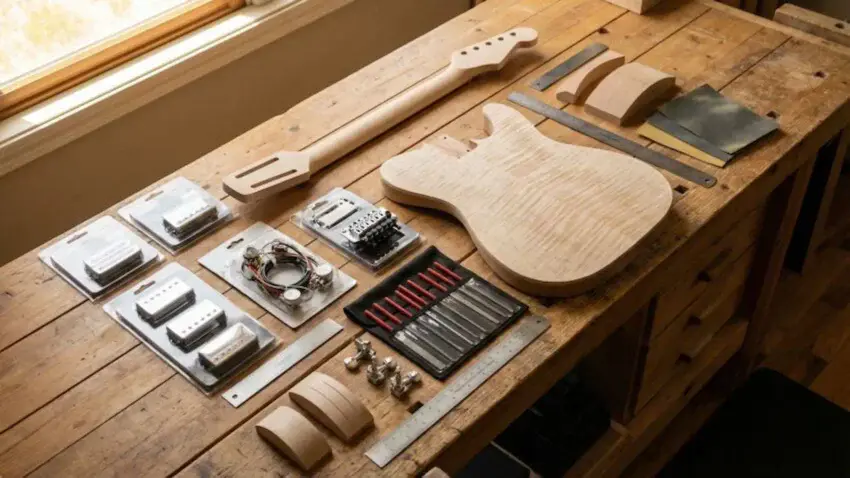
Building a premium instrument starts long before the
first string ever goes on, and that’s exactly what this
Best Pro-level Electric Guitar Kit Build Guide
is designed to help you master.
Whether you’re leveling up from beginner kits or
stepping straight into high-end components,
this guide walks you through every step of the
process — planning, prep work, tools,
techniques, and pro-grade finishing methods
— so you can build a guitar that looks, feels,
and sounds like a true custom shop piece.

🛠️ Recommended Tools
for a Pro-Level Build
When you’re stepping into a higher-end kit,
the right tools make all the difference.
These are the exact precision tools I rely on
for accurate measurements, clean nut work,
proper action setup, and a flawless final build.
If you want pro-quality results from your kit,
these five essentials will get you there.
⭐ MusicNomad Precision
String Action Gauge Ruler
If you want dead-accurate action setup on your
pro-level kit, this gauge takes all the guesswork out.
Perfect for dialing in your build during final setup.
 Amazon Product Suggestion:
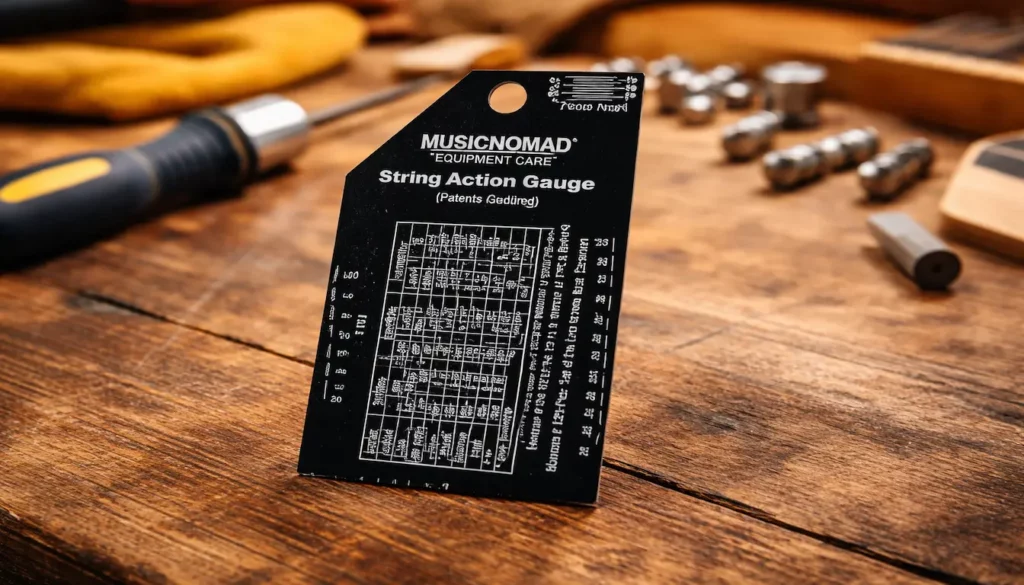
 MusicNomad Precision
String Action Gauge Ruler
(MN602)
The MusicNomad MN602 String Action Gauge
is a precision stainless-steel ruler designed
to help you dial in perfect string height on
electric, acoustic, and bass guitars.
With easy-to-read etched markings in
metric, SAE, and 64ths, it takes the
guesswork out of action setup and ensures
repeatable, pro-level results every time.
Why It’s Great:
Clear, precise measurements with no fading
Works for electric, acoustic, and bass
High-contrast markings for easy reading
Durable stainless steel for long-term use
⭐ Jivarrry Digital Caliper
(6-Inch)
This is the same style of caliper you rely on every day —
perfect for checking nut width, fret wire, saddle height,
and hardware dimensions with absolute precision.
Amazon Product Suggestion:
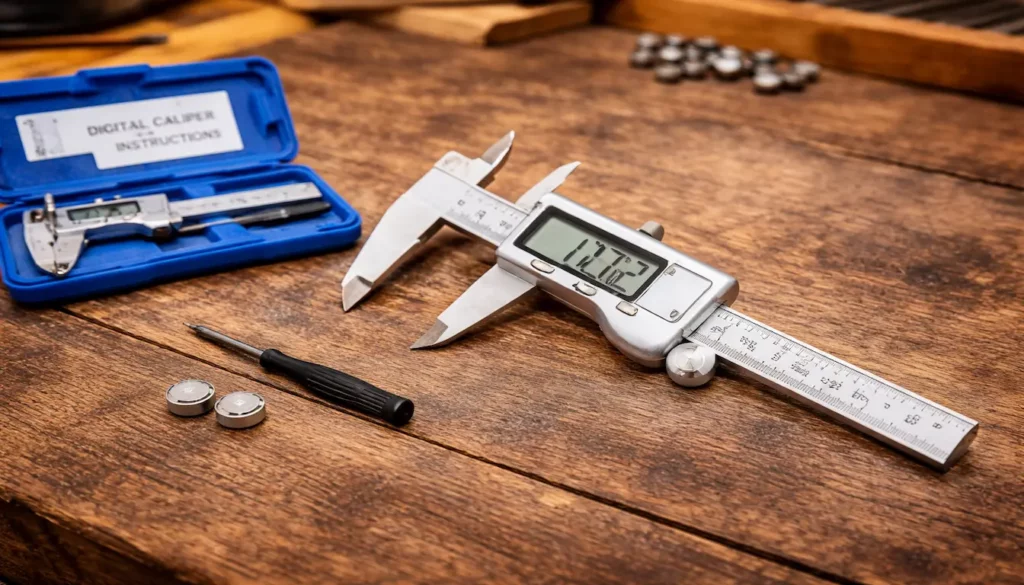
Jivarry Digital Caliper
(6-Inch)
The Jivarry Digital Caliper is an affordable,
accurate measuring tool that every
woodworker should keep in their shop.
With a smooth stainless-steel slide,
a large easy-to-read LCD, and
instant switching between
inches, millimeters, and fractions,
it makes precise measuring fast
and frustration-free.
Why it’s great:
Large, easy-to-read digital display
Instant unit switching (inch/mm/fractions)
Smooth, accurate stainless steel body
Measures inside, outside, depth, and step
⭐ 25Pcs Guitar Repairing
Tools Setup Kit
(with Carry Bag)
A complete all-in-one setup kit — perfect for
fretwork, adjustments, truss rod tweaks, and
final build tuning without hunting for individual tools.
Amazon Product Suggestion:
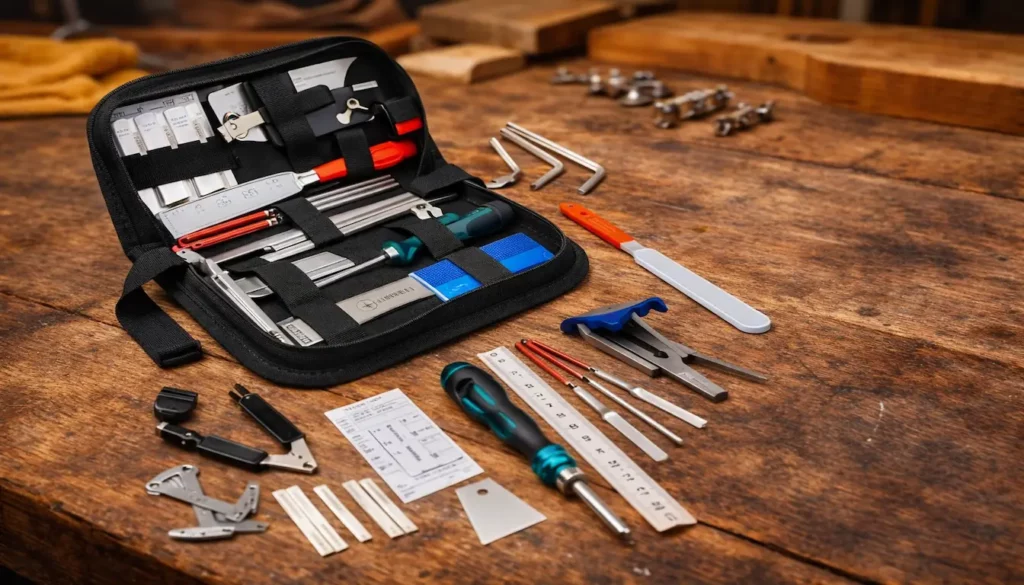
25Pcs Guitar Repairing
Tools Kit Setup Kit
This 25-piece guitar repair and setup kit
gives you all the essential tools needed for
adjusting action, filing frets, setting intonation,
and performing basic maintenance on
electric, acoustic, bass, or ukulele.
Compact, organized, and ideal for beginners
or experienced DIY guitar techs.
Why It’s Great:
All-in-one kit with essential setup tools
Ideal for pickup, nut, and bridge adjustments
Works for electric and acoustic guitars
Compact case keeps everything organized
⭐ 4. MusicNomad
Precision Nut Files
If you want clean, buzz-free nut slots on a
pro-level build, these files deliver the accuracy
and smooth cutting action that cheap sets can’t touch.
Amazon Product Suggestion:
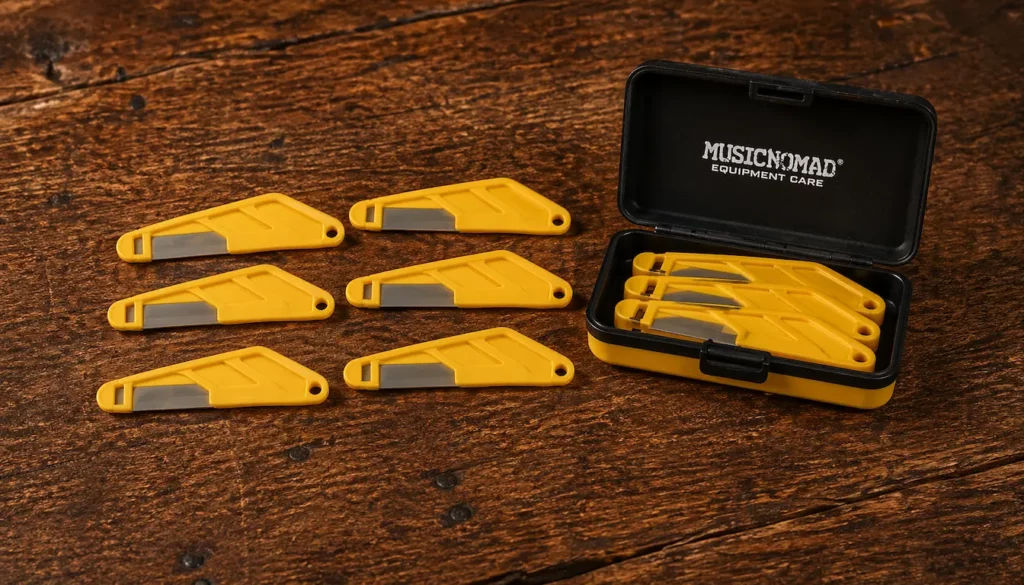
MusicNomad 6-pc
Diamond Nut File Set
A pro-level set of diamond-coated nut files
that cut clean, precise slots every time.
Each file is matched to common light/medium
string gauges, giving you accurate
sizing without overcutting.
Comfortable handles and a sturdy storage case
make this a killer upgrade for any setup bench.
Why It’s Great:
Diamond-coated for smooth, controlled cutting
Six gauges for perfect nut-slot sizing
Comfortable grip handles
Tough storage case included
⭐ Hosco Nut
Slotting Gauge
A must-have companion tool for nut work,
this gauge helps you measure and set the
exact string spacing and slot depth
before you ever touch a file.
Amazon Product Suggestion:
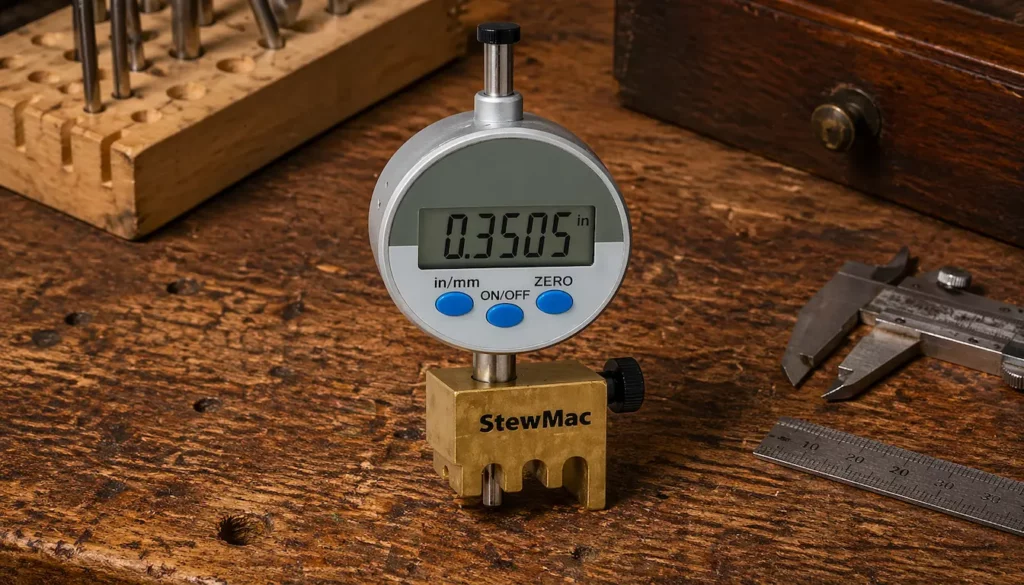
StewMac Digital Nut
Slotting Gauge
This digital gauge gives you
pinpoint nut slot accuracy
down to 0.001″ / 0.01mm.
The brass base sits solid on the fretboard
while the digital plunger shows your
exact string height in real time.
Perfect for cutting smooth, buzz-free
nut slots with pro-level precision.
Why it’s great:
Ultra-precise accuracy for perfect nut slots
Digital readout for fast, repeatable measurements
Stable base sits flat on the fretboard
Ideal for low-action, buzz-free setups
🎸 What Makes a
Pro-Level Guitar Kit?
Not all guitar kits are built the same,
and once you step into the pro-level category,
the difference becomes obvious fast.
These kits use better woods, tighter tolerances,
and higher-grade components that let you build
an instrument worthy of real stage time —
not just a fun weekend project.
If you’ve only worked with beginner kits before,
here’s what sets the premium ones apart:
• Higher-Quality Tonewoods
Pro kits use mahogany, alder, ash, and figured
maple tops with more consistency in
weight, grain, and density.
That means better sustain, richer tone,
and a cleaner final finish.
• Cleaner Routing
& Better Fitment
The cavities, neck pockets, and hardware routes
are far more precise.
Parts line up the way they should,
which saves you from having to
“fix the kit before you build it.”
• Upgraded Hardware
Out of the Box
Bridges, tuners, pots, switches, and jacks
are noticeably higher quality.
Even if you upgrade later,
you start from a stronger foundation.
• More Reliable
Neck Construction
Straighter neck blanks, smoother fret ends,
tighter joints, and more consistent radius work.
This means WAY less fret dressing and
fewer surprises during setup.
• Finish-Ready Surfaces
Pro-level kits can take dye, stain, oil,
or a full gloss finish much better.
The grain is cleaner, the sanding is more consistent,
and the tops (especially maple) are often stunning.
• Built with Upgrades in Mind
These kits expect you to swap pickups, nuts, caps, and hardware —
So, they’re made to handle those changes without extra mods.
• The Price Reflects the Potential
You’re paying for better materials, precision,
consistency, and tone.
And the truth is simple:
A pro-level kit gives you a real chance to build a guitar that
feels and sounds like something straight out of a custom shop.
🪚 Step-By-Step:
How to Build a
Pro-Level Guitar Kit
Putting together a premium kit isn’t just about
following instructions — it’s about taking your time,
working with precision, and treating every stage
like you’re building a custom-shop instrument.
Here’s the full process I use when I’m
shooting for the best results possible.
1. Unbox, Inspect,
and Test-Fit Everything
Lay out all parts and check the
body, neck, routing, and hardware.
Look for cracks, gaps, rough spots,
or anything that needs attention before you begin.
Fit the neck into the pocket, line up the bridge,
and make sure everything sits where it should.
2. Evaluate the Fretwork
Even good kits need fret attention.
Check for high spots using a fret rocker,
feel for sharp edges, and sight down the
neck to see if there’s any twist or bow.
Make note of any frets that need leveling.
3. Sanding: The Foundation
of a Clean Build
Start with 180–220 grit depending on the roughness.
Sand with the grain, keep edges crisp,
and work your way up through the finer grits.
This stage determines how good your finish will look,
so don’t rush it.
4. Grain Fill (If Needed)
Open-grain woods like mahogany, ash,
and walnut require grain filler for a smooth finish.
Apply, scrape, sand back,
and repeat until the surface is flat.
This step alone can take your build
from “DIY kit” to “custom shop.”
5. Neck Prep and Refinement
Smooth the back of the neck, soften the edges if
you prefer a broken-in feel, and polish the fretboard.
Mask off the frets if you’re planning any fretwork later.
6. Fret Leveling,
Crowning & Polishing
Use your leveling beam to establish an even playing field.
Re-crown each fret with a precision file,
then polish them to a mirror shine.
Good fretwork makes more difference
than any pickup upgrade.
7. Apply Your Finish
(Stain, Dye, Oil, Poly, Nitro)
This is where your guitar’s personality comes out.
Whether you’re going for a natural oil finish,
a full gloss, or a burst, take your time with
the coats and curing.
Thin coats always look better than heavy ones.
8. Shielding the Cavities
Line the control and pickup cavities
with copper shielding tape.
This step reduces hum and noise.
This step is especially important for
single-coil builds or high-gain players.
9. Wiring & Electronics
Install the pots, switch, jack, and pickups.
Keep your solder joints clean and shiny.
Use heat-shrink tubing on exposed leads,
and route the wiring neatly to avoid noise issues later.
10. Final Assembly
Install the tuners, bridge, pickguard,
and all remaining hardware.
Mount the neck and make sure it’s aligned perfectly
with the centerline of the guitar before
tightening things down.
11. Setup: Action, Relief,
Intonation, and Pickup Height
Adjust the truss rod for proper neck relief,
set your string height using your action gauge,
set intonation, and dial in pickup height.
This is where your build “comes alive.”
12. Play-Test and Fine-Tune
Plug in, check for buzzes, dead spots,
grounding issues, or scratchy pots.
Make small tweaks until everything
feels and sounds right.
A pro-quality guitar always gets a
final pass before calling it done.
🎸Looking for a Reliable
Pro-Level Kit to Start With?
If you want consistent routing, quality tonewoods,
and kits that truly respond to advanced build techniques,
Solo Guitars is the brand I trust the most.
👇 Check out my full Solo Guitars DIY kit guide:

🎯 Final Thoughts…
Building a pro-level electric guitar kit isn’t just another
DIY project — it’s a chance to create a personalized
instrument with the look, feel, and tone of a
true custom-shop guitar.
When you take your time with the prep work,
use the right tools, and follow a structured build process,
the results can be better than many factory-built guitars
on the market.
Whether you’re dialing in your fretwork,
experimenting with finishes,
or upgrading hardware along the way,
each step brings you closer to a guitar
that’s uniquely yours.
And if you decide to start with a higher-quality kit,
your build experience gets smoother,
your results get cleaner, and your
finished instrument becomes something
you’ll be proud to play every day.
Take your time, trust the process,
and enjoy the build.
That’s where the real magic happens.
 Ready to Start?
Here’s your next step —
pick one and go:
 New to guitar kits?
Start with
Step-by-Step Guide To Building
Your First Electric Guitar Kit
and
Essential Tools Every Electric Guitar Kit
Builder Should Have.
Already built a kit?
Jump into
How To Properly Set Up Your
Electric Guitar Kit For Intonation
or
Fixing Common Problems:
Buzzing And Dead Frets.
Chasing better tone?
Head to
Understanding Humbucker
Vs Single Coil Pickups In Kits
or
Playing With Tone Controls:
Tips For Electric Guitar Kits
and start experimenting.
 Your Guitar, Your Build,
Your Sound
You don’t need a custom shop or a tech on speed dial.
All you need is a little guidance, some patience,
and a place to go that shows you what to do next.
Come on man… You got this.
GuitarCrafts
is here to help you along the way.
Craft it. Play it. Own it!