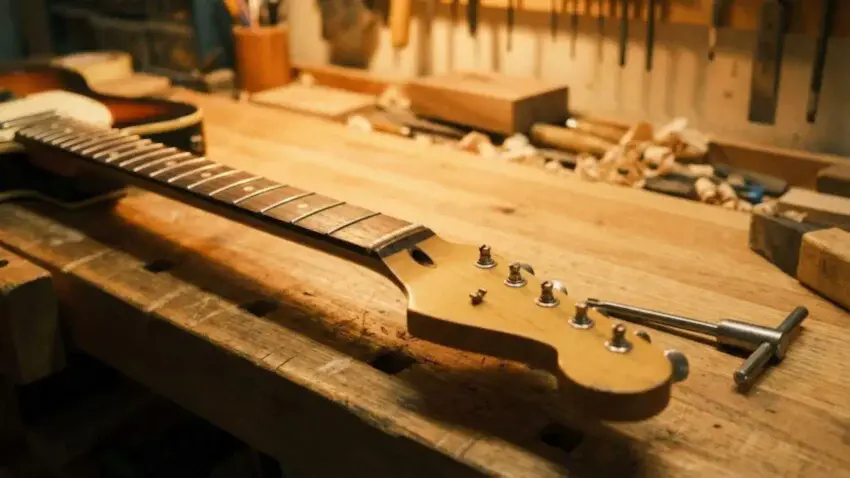
How to adjust a guitar truss rod is one of the most important setup skills for improving playability
when a guitar starts buzzing, feels stiff, or develops high action.
The truss rod controls neck relief, which directly affects how comfortable and clean your guitar feels.
Too much relief makes a guitar hard to play, while too little can cause fret buzz and dead notes.
Because humidity, temperature, and string gauge change over time,
truss rod adjustments are a normal part of guitar maintenance.
This guide shows you how to adjust a guitar truss rod safely and avoid common beginner mistakes.

🎸 Tools You’ll Need Before Adjusting a Guitar Truss Rod
Before adjusting your truss rod, having the right tools makes the process safer and more predictable.
The items below cover the basics for checking neck relief, making small adjustments,
and retuning accurately without guesswork.
🔧 MusicNomad Premium Truss Rod Wrench
This dedicated 5mm truss rod wrench is designed for guitars that require a precise fit.
Using the correct size helps prevent stripping the nut and reduces the risk of forcing the truss rod.
 Amazon Product Suggestion:
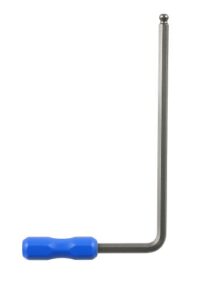
 MusicNomad Premium Truss Rod Wrench
5mm (MN236)
If you’re working on a Martin-style guitar or any kit that uses a 5mm truss rod nut, this wrench is the one you want in your setup bag. The ball-end design makes adjustments easy even at awkward angles, and the ergonomic blue handle gives you tons of control without digging into your hand. MusicNomad tools are known for reliability, and this one delivers smooth, precise neck-relief tweaks every time.
Why It’s Great:
✔ Designed for 5mm Martin-style truss rods
✔ Ball-end tip allows adjustments in tight spaces
✔ Durable steel construction for long-term use
✔ Laser-etched size prevents mix-ups with other wrenches
📏 CruzTOOLS GTGTR1 GrooveTech Guitar Player Tech Kit
This all-in-one tech kit covers the basic tools needed for routine guitar setup and maintenance.
It’s a convenient option if you want everything in one place without hunting down individual tools.
Amazon Product Suggestion:
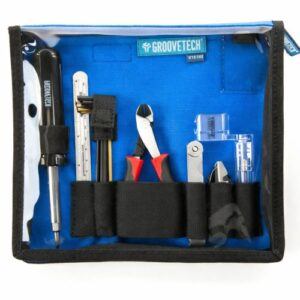
CruzTOOLS GTGTR1 GrooveTech Guitar Player Tech Kit
The CruzTOOLS GTGTR1 GrooveTech Guitar Player Tech Kit is a compact, all-in-one solution for basic guitar maintenance, adjustments, and emergency fixes. Designed for players who want professional-grade tools without carrying a full bench setup, this kit keeps everything organized and ready to go.
This kit includes feeler gauges along with other essential setup tools, making it a convenient all-in-one option for truss rod adjustments and basic guitar maintenance.
Why It’s Great:
Complete player-focused setup kit for guitars and basses
Includes essential tools for string changes, adjustments, and measurements
Durable zippered pouch keeps tools secure and organized
Ideal for home setups, gig bags, and travel use
📐 MusicNomad Precision String Action Gauge Ruler
This precision ruler makes it easy to measure string height and neck relief accurately during setup.
Clear markings in metric, SAE, and 64ths help remove guesswork and keep adjustments consistent.
Amazon Product Suggestion:
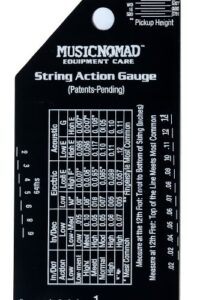
MusicNomad Precision String Action Gauge Ruler
for String Height- Metric, SAE, 64ths
(MN602)
The MusicNomad MN602 String Action Gauge is a precision stainless-steel ruler designed to help you dial in perfect string height on electric, acoustic, and bass guitars. With easy-to-read etched markings in metric, SAE, and 64ths, it takes the guesswork out of action setup and ensures repeatable, pro-level results every time.
Why It’s Great:
✔ Ultra-precise etched measurements with high-contrast markings
✔ Works for electric, acoustic, and bass guitars
✔ Built-in action charts for quick, reliable setup targets
✔ Durable pocket-size stainless steel design for long-term use
🎸 Kyser Quick-Change Capo For 6-String
A capo helps hold the string at the first fret so you can measure neck relief consistently.
A quick-change design makes it easy to move on and off the neck while you’re making adjustments.
Amazon Product Suggestion:
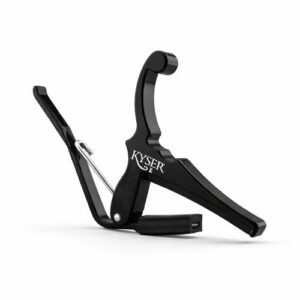
Kyser Quick-Change Capo For 6-String
(Electric Guitar – Black)
The Kyser Quick-Change Capo for 6-String Electric Guitar is a simple, reliable choice for first-time builders and players who want instant results without overthinking their gear. Designed specifically for electric guitars, it applies the right amount of pressure to keep notes clean and in tune without pulling strings sharp.
Why It’s Great:
Designed for 6-string electric guitars with proper spring tension
One-hand operation makes it fast and beginner-friendly
Durable, no-nonsense design trusted by players worldwide
Easy to move or remove without interrupting your playing
🔄 D’Addario Accessories Pro-Winder
A string winder isn’t required for truss rod adjustments, but it makes loosening and retuning much faster.
It’s a small convenience that saves time and reduces hand fatigue during setup work.
Amazon Product Suggestion:
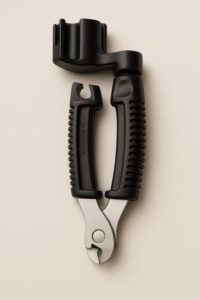
D’Addario Accessories Pro-Winder
(Guitar String Winder)
A clever all-in-one tool that speeds up every string change.
Smooth winding, clean cuts, and a built-in bridge-pin puller
make this a compact must-have for any guitarist.
Why It’s Great:
Winder + cutter + pin puller
Fast, smooth operation
Clean, precise cuts
Works on electric & acoustic
🤘🤘 Once you’ve got the right tools on hand,
the next step is making sure a truss rod adjustment is actually needed.
Before turning anything, it’s important to understand what neck-related problems look like —
and what issues may be caused by something else.
Diagnosing Neck Problems Before Adjusting
Before adjusting a truss rod, it’s important to confirm that the neck is actually the problem.
Common symptoms include fret buzz, unusually high action, or notes that don’t ring out cleanly —
but these issues aren’t always caused by neck relief alone.
Neck problems usually develop gradually.
Changes in humidity, temperature, string tension, and regular playing can all cause the neck to
shift over time, which is why diagnosis should always come before adjustment.
Understanding the difference between forward bow and backbow is key.
Too much forward bow adds excess relief and raises the action, while backbow flattens the neck too much
and often causes fret buzz, especially on the lower frets.
Looking down the neck and feeling the string height can help identify which condition is present.
Not every playability issue requires a truss rod adjustment.
Loose hardware, uneven frets, or bridge problems can create similar symptoms,
so once those are ruled out and neck relief is confirmed to be off,
adjusting the truss rod becomes the appropriate next step.
⚠️ Important: When NOT to Adjust the Truss Rod
If the truss rod feels unusually stiff, won’t turn, or seems maxed out, stop immediately.
Forcing a truss rod can cause serious and permanent neck damage.
Likewise, if buzzing persists after small adjustments or the neck appears twisted, the issue may not be truss rod–related. In those cases, it’s best to consult a qualified guitar tech.
Performing a Truss Rod Adjustment Safely
Once you’ve confirmed the neck relief is the issue, you can move on to adjusting the truss rod.
While it may seem intimidating at first, a slow and careful approach keeps the process safe and manageable.
Start by gathering the proper tools.
In most cases, you’ll need the correct Allen wrench or truss rod tool for your guitar
and a ruler to check neck relief.
Before turning anything, slightly loosen the strings to reduce tension and note whether the
truss rod adjusts at the headstock or the heel of the neck.
Always make adjustments in small increments.
A quarter-turn or less is usually enough.
Turning clockwise tightens the rod and reduces neck relief, while turning counterclockwise loosens it
and increases relief.
If the rod resists strongly, stop immediately — never force it.
After each adjustment, retune the guitar and recheck the neck relief.
Play across the fretboard to listen for buzz and assess overall comfort.
A few small adjustments may be needed, but patience and measured changes lead to a stable,
comfortable setup.
Long-Term Maintenance and Common Mistakes to Avoid
Once your guitar is playing well, regular checks help keep it that way.
Seasonal changes in humidity and temperature can affect neck relief over time,
so it’s smart to stay aware of how your guitar feels throughout the year.
A truss rod adjustment isn’t a one-time fix.
Checking neck relief every few months — or anytime playability changes — is usually enough.
Small, occasional adjustments are far safer than waiting until problems become obvious.
One of the most common beginner mistakes is making large adjustments too quickly.
Truss rods should always be adjusted gradually, using small turns and rechecking the results.
Over-tightening is especially risky and can lead to serious neck damage.
Knowing when to stop is just as important as knowing how to adjust.
If the truss rod feels unusually stiff, won’t turn, or the guitar still won’t play correctly
after careful adjustments, it’s best to consult a professional.
Treating truss rod adjustments as regular maintenance — not emergency repairs —
helps keep your guitar comfortable, stable, and sounding its best.
🎸 Final Thoughts…
Adjusting a guitar truss rod doesn’t have to be intimidating.
With the right tools, small adjustments, and a patient approach,
it becomes a simple part of regular guitar maintenance.
The key is knowing when an adjustment is needed — and when it isn’t.
Taking time to diagnose the problem first, making gradual changes, and stopping if something doesn’t feel right will keep your guitar playing comfortably and sounding its best.
Treat truss rod adjustments as routine upkeep, not emergency fixes,
and you’ll build confidence every time you work on your instrument.
Ready to Start Adjusting Your Tone?
Check out our other guides:
 If you’re new to guitar kits:
Start with Step-by-Step Guide To Building Your First Electric Guitar Kit and Essential Tools Every Electric Guitar Kit Builder Should Have.
If you already own a kit guitar:
Jump into How To Properly Set Up Your Electric Guitar Kit For Intonation or Fixing Common Problems: Buzzing And Dead Frets.
If you’re chasing better tone:
Head to Understanding Humbucker Vs Single Coil Pickups In Kits or Playing With Tone Controls: Tips For Electric Guitar Kits and start experimenting.
Your Guitar, Your Build, Your Sound
You don’t need a custom shop or a tech on speed dial.
All you need is a little guidance, some patience, and a place to go that shows you what to do next.
Come on man… You got this.
GuitarCrafts is here to help you along the way.
 Craft it. Play it. Own it!
Ready to take your guitar passion beyond the workbench?
See how I built GuitarCrafts.com using the training at Wealthy Affiliate — you can do the same.
Build Your First Website With Wealthy Affiliate (Free)
