
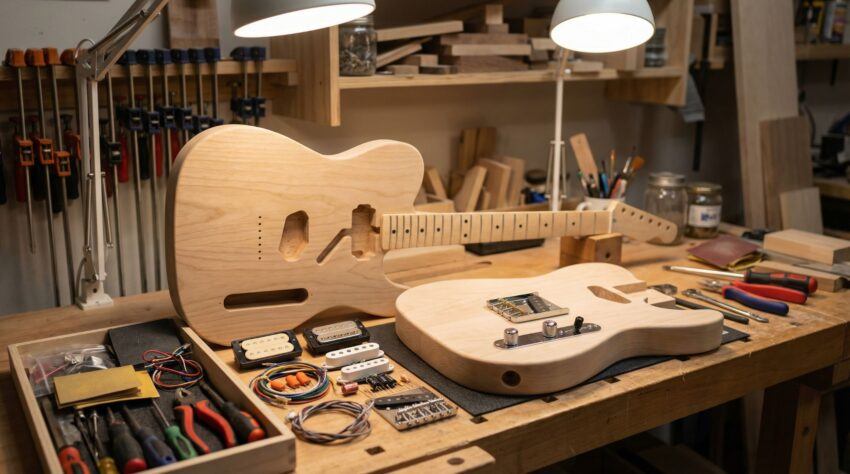
If you want to shape your own sound and really understand what goes into an electric guitar,
building one from a DIY kit is one of the most rewarding ways to do it.
In this guide to Top DIY Electric Guitar Kits For Custom Tone,
I’ll break down what actually matters when choosing a kit and highlight some of the best options
for dialing in custom tone without blowing your budget.
 This guide is part of my Solo Guitar Kits hub,
where I collect Solo-exclusive kit guides and comparisons to help builders choose the right kit.

 About These Kits
Whether you’re chasing classic tones, vintage-inspired designs, or modern performance,
these Solo Guitars DIY electric guitar kits give you the freedom to build exactly what you want.
From familiar S-style and semi-hollow builds to bold offsets and a modern headless design,
each kit offers quality components and a solid foundation for a truly personal guitar.
Solo STK-1 DIY Electric Guitar Kit
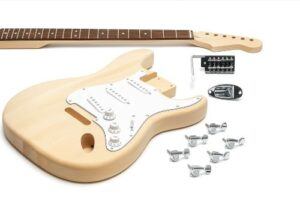
The Solo STK-1 DIY Electric Guitar Kit is a classic S-style build that’s perfect for players who want
familiar tone and feel with full customization freedom. With its maple neck and traditional body shape,
it’s an excellent choice for first-time builders or anyone looking for a reliable, versatile project guitar.
 Solo Guitars Product:
 Solo STK-1 DIY Electric Guitar Kit
(Maple Neck • S-Style)
If you want a classic Strat-style kit that’s easy to assemble
and perfect for your first (or next) custom guitar, the STK-1 is a killer choice.
It’s lightweight, beginner-friendly, and gives you that timeless S-style look with three single coils
ready to dial in everything from clean sparkle to crunchy blues tones.
A great pick if you want a simple, affordable kit that still gives you plenty of room to
mod, upgrade, and make it your own.
Why It’s Great:
Smooth, contoured Strat-style body with classic S-shape
Maple neck for bright tone and stable tuning
Easy, beginner-friendly build with all hardware included
Perfect platform for painting, staining, and pickup upgrades
Best Solo Guitar Kits (My Top Picks)
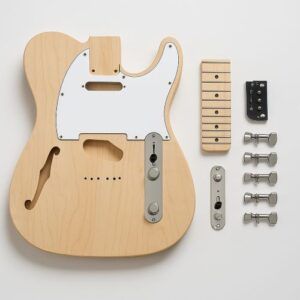
The Solo TCK-100 Semi-Hollow Electric Guitar Kit blends classic style with a lighter,
more resonant feel that players love. Featuring a maple top and semi-hollow construction,
it’s a great choice for builders looking for warm tone, smooth playability,
and vintage-inspired character.
Solo Guitars Product:
Solo TCK-100 Semi-Hollow Kit
(Maple Top)
If you want a DIY kit with a richer, more expressive tone, the TCK-100 Semi-Hollow is a fantastic pick.
It’s light, easy to assemble, and the maple top looks amazing under almost any finish.
A great choice if you want something a little classier than a solid-body without adding extra build difficulty.
Why It’s Great:
Warm, resonant semi-hollow tone
Beautiful maple top for clear or tinted finishes
Easy, beginner-friendly build
Lightweight and super comfortable to play
Solo JMK-90 DIY Electric Guitar Kit
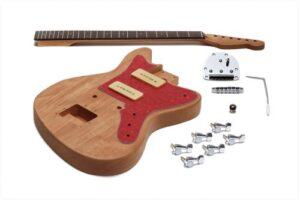
The Solo JMK-90 DIY Electric Guitar Kit delivers a bold offset design paired with classic tones and modern playability. It’s a great build for players who want something visually distinctive while still enjoying familiar single-coil style sounds and comfortable ergonomics.
Solo Guitars Product:
Solo JMK-90 DIY Electric Guitar Kit
If you want an offset kit with punchy P-90 tone and a super comfortable feel, the JMK-90 nails it.
Lightweight, easy to assemble, and packed with vintage-style character —
It’s a killer choice if you want something unique without making the build harder.
Why It’s Great:
Comfortable offset body shape
Warm, gritty P-90 tone
Beginner-friendly build
Lightweight and fun to play
Solo PRK-0T DIY Electric Guitar Kit
The Solo PRK-OT DIY Electric Guitar Kit offers a classic single-cut design with the punch and sustain players expect from dual humbuckers. It’s a solid choice for builders who want a straightforward
assembly with plenty of room for custom finishes and hardware upgrades.
Solo Guitars Product:
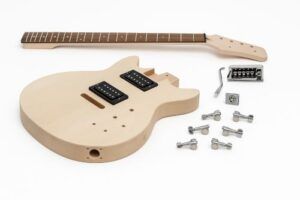
Solo PRK-0T DIY Electric Guitar Kit
If you want an LP-style build that keeps things simple,
clean, and beginner-friendly, the Solo PRK-0T is a solid choice.
It delivers that classic dual-humbucker punch without the heavy carved top
or complicated wiring work found on higher-end LP kits.
You get a comfortable flat-top body, a smooth maple neck,
and all the hardware you need for a straightforward, frustration-free build.
This kit is perfect if you want the LP look and sound without the extra weight or build complexity.
Why It’s Great:
Classic dual-humbucker tone with plenty of punch
Flat-top design = easier sanding, finishing, and polishing
Beginner-friendly layout with a clean, simple build process
Lightweight feel compared to traditional carved-top LP bodies
Solo SBK-150 DIY Headless Electric Guitar Kit
The Solo SBK-150 DIY Headless Electric Guitar Kit is perfect for builders looking to create a modern, lightweight guitar with excellent balance and tuning stability. Its headless design and precision-cut components make it a rewarding project for players ready to step beyond traditional guitar kits.
Solo Guitars Product:
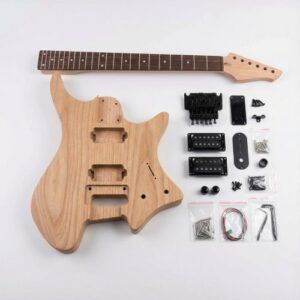
Solo SBK-150 DIY Headless Electric Guitar Kit
The Solo SBK-150 DIY Headless Electric Guitar Kit is a modern, performance-focused build designed for players who want excellent balance, tuning stability, and a sleek headless look. It’s a great option for builders ready to step beyond traditional guitar kits and create something truly unique.
Why It’s Great:
✔ Headless Design – Improves balance, reduces neck dive, and keeps tuning rock solid
✔ Pre-Routed Solid Wood Body – Clean, accurate routing for straightforward assembly
✔ Bolt-On Neck – Comfortable profile with smooth access across the fretboard
✔ Complete Headless Hardware – Purpose-built bridge and tuning system included
🤘🤘 Ready to Go Beyond the Kit?
Now that you’ve seen what makes these Solo Guitars kits great,
let’s zoom out for a moment and look at why DIY electric guitar kits continue to
hook players in the first place — and why building your own instrument
is about more than just the finished guitar.
🎸 Why DIY Electric Guitar Kits Appeal To Players
DIY electric guitar kits have become increasingly popular with players who want more control
over their sound and a deeper connection to their instrument.
There’s something uniquely satisfying about plugging in and hearing the first notes come from
a guitar you assembled yourself — especially when every component was chosen with tone in mind.
Unlike buying a finished guitar off the rack, a kit gives you real choices over wood type,
pickups, hardware, and electronics.
Most kits include everything needed to get up and playing,
while still leaving room to upgrade parts or customize finishes along the way.
That flexibility is what makes kits especially appealing to players chasing a specific feel or sound.
Thanks to improved designs and better availability from online retailers,
today’s DIY guitar kits range from beginner-friendly builds to platforms suited for experienced builders.
With a little patience and basic setup work, building a kit becomes less intimidating than it sounds —
and the skills you learn carry over into future upgrades, maintenance, and tone shaping.
🧩 What To Consider Before Buying A DIY Guitar Kit
Before choosing a DIY guitar kit, it helps to understand which factors will actually affect tone, playability,
and how much customization you’ll be able to do. Here’s what I look at before adding a kit to my cart:
- Wood and Body Style:
Body wood influences both tone and weight, so think about whether you prefer something
heavier like mahogany or lighter options such as alder or basswood.
Body style (Strat, Tele, Les Paul–style, etc.) also plays a role in feel and resonance,
and some kits offer more unique or exotic wood options if appearance matters as much as sound. - Pickups and Electronics:
Pickup quality varies widely between kits.
Some include basic ceramic pickups, while others step it up with higher-end components.
Many builders plan to upgrade later, but if you want strong tone right out of the gate,
pay close attention to what electronics are included. - Kit Completeness:
Some kits truly include everything needed to assemble the guitar,
while others may require additional items like solder, finishing supplies, or tools.
Knowing this upfront helps avoid surprises once you start the build. - Skill Level:
Beginner-friendly kits often come with pre-drilled holes and simpler wiring,
while more advanced kits leave room for custom routing, finishing, and electronic modifications.
If you enjoy experimenting and upgrading, choose a kit that gives you flexibility. - Instructions and Support:
Clear instructions can make a huge difference, especially for first-time builders.
Some brands provide detailed guides, while others rely more on community support
and online resources. Build logs and tutorials can be invaluable if you run into issues.
It’s also worth setting a realistic budget and accounting for potential upgrades
like tuners or pickups down the line.
Shipping costs can vary as well, especially for heavier kits,
so factor that in before pulling the trigger.
🎛️ Best DIY Electric Guitar Kits for Custom Tone
The DIY guitar kit market keeps improving, with more options covering everything from classic designs to modern, experimental builds. Rather than focusing on individual models right away, it helps to understand the main kit styles that consistently offer the most flexibility for dialing in custom tone and feel.
- Fender-Style (Strat / Tele) Kits:
These are popular for a reason. Fender-style kits are beginner-friendly, widely available, and easy to customize. Pickguards, pickups, and wiring layouts can be swapped with minimal effort, making them a solid choice if you plan to experiment with tone upgrades over time. - Les Paul–Style Kits:
Known for their thicker bodies, set necks, and strong sustain, Les Paul–style kits often require a bit more patience during assembly. In return, they offer a warm, powerful tone and plenty of room for visual upgrades like figured tops and custom finishes. - Offset (Jazzmaster / Jaguar) Kits:
Offset kits appeal to players looking for something a little different. Wiring can be more complex, but these designs reward builders with unique tones and a distinct feel that stands apart from traditional body shapes. - Hollow Body and Semi-Hollow Kits:
These kits are ideal for players chasing airy resonance and dynamic response. While internal wiring takes more care, the tonal payoff makes them a favorite for jazz, blues, and expressive playing styles. - Headless and Modern Kits:
Modern kits focus on comfort, balance, and portability. With lighter materials and simplified hardware, they offer a sleek alternative for players who want contemporary looks and a fast, minimalist feel.
Each of these kit styles offers a different path toward custom tone and playability.
The best choice depends on your experience level, the sound you’re chasing,
and how much customization you want to tackle during the build.
💰 Are DIY Electric Guitar Kits Worth It?
DIY electric guitar kits can be a great value if you enjoy hands-on projects and want real control
over how your guitar looks, feels, and sounds.
Building your own instrument lets you tailor everything from pickups to hardware,
and the satisfaction of playing something you assembled yourself is hard to match.
For many players, that experience alone makes a kit worthwhile.
For first-time builders, it’s common to worry about whether the finished guitar will feel or sound “right.”
In practice, many kit builds end up becoming go-to instruments or trusted backups.
Kits also provide a low-risk way to learn basic setup, maintenance, and modification skills,
making them ideal platforms for future upgrades or tone experiments.
That said, DIY guitar kits aren’t for everyone.
If you’re not interested in assembly, troubleshooting, or setup work,
or if you expect custom shop results straight out of the box, a kit may not be the best fit.
But for players who enjoy learning by doing and don’t mind rolling up their sleeves,
DIY electric guitar kits offer a rewarding path to creating
a personalized instrument from the ground up.
🛠️ Is It Cheaper To Build A Guitar From Scratch?
In most cases, building a guitar from a DIY kit is more affordable than
starting completely from scratch or buying a factory guitar with similar features.
Basic kits often start around the lower end of the price range,
while higher-end kits with better woods and hardware can cost more.
Even so, kits usually remain cheaper than sourcing every component individually.
Building from scratch requires purchasing all materials separately —
body and neck blanks, fretwire, hardware, electronics, finishing supplies, and specialized tools.
Once those costs are added up, scratch builds tend to become more expensive and time-consuming,
especially for first-time builders.
DIY kits strike a balance between cost and customization.
They provide the core components while still allowing upgrades to pickups, hardware, or finishes over time. While premium upgrades can raise the final cost,
most builders still end up spending less than they would on a comparable factory guitar with similar specs.
Along the way, you also gain hands-on experience and a deeper understanding of
how electric guitars are built, finished, and set up.
🎶 What Are the Most Popular Electric Guitar Styles—and Why They Matter for DIY Kits
When people ask about the “best” or “best-selling” electric guitars,
the answers usually point to a handful of classic designs that have stood the test of time.
Strat-style and Tele-style guitars continue to dominate thanks to their versatility,
comfortable playability, and wide tonal range.
These designs are also the foundation for many DIY guitar kits,
making them a popular choice for first-time builders and experienced modders alike.
Single-cut designs inspired by Les Paul–style guitars remain favorites for players
chasing sustain, warmth, and a thicker tone.
These styles often translate well into DIY kits,
especially for builders interested in set-neck construction and upgraded hardware.
Modern interpretations, including sleek, performance-focused designs, have also gained traction
and influenced newer kit options aimed at players who prioritize comfort and contemporary features.
The popularity of these classic guitar styles carries over directly into the DIY kit world.
Familiar shapes, readily available replacement parts, and proven tone profiles make them
ideal platforms for customization, upgrades, and experimentation.
🤘 Tips For A Smooth DIY Build
A little preparation goes a long way when building a DIY electric guitar kit.
These tips can help you avoid common mistakes and keep the build process moving smoothly:
- Check all parts before starting:
Lay everything out and confirm you have all screws, springs, wires, and hardware before reaching for glue or a soldering iron. Catching missing or incorrect parts early saves time and frustration later. - Dry fit everything first:
Assemble the body and neck without glue to make sure everything lines up properly. Checking alignment now makes it much easier to fix gaps or fit issues before anything becomes permanent. - Patience is your best friend:
Let finishes cure fully between coats and take your time with wiring. Rushing the process is one of the most common causes of cosmetic flaws and electronic issues, even for experienced builders. - Use community resources:
Online build forums, videos, and shared build logs are invaluable when instructions fall short or unexpected problems come up. Seeing how other builders solved similar issues can save hours of trial and error.
A little extra prep at this stage pays off later during setup, tuning, and intonation.
Having basic tools on hand — such as a quality screwdriver set, wire strippers, sandpaper,
and finishing supplies — makes the entire process easier and more enjoyable.
Building your own electric guitar is a rewarding project,
whether you’re looking for a reliable backup instrument
or a platform for customization and upgrades.
DIY guitar kits offer solid playability right out of the gate while giving you
the freedom to experiment with tone, hardware, and finishes.
If you enjoy hands-on projects and want a guitar that reflects your personal style,
a DIY kit is a great place to start.
🧠 Final Thoughts…
DIY electric guitar kits aren’t just a project —
they’re a hands-on way to better understand your instrument
and take control of your tone.
From choosing woods and pickups to wiring and finishing,
every step teaches you something new about how electric guitars
are built, set up, and maintained.
While kits may not replace a high-end custom shop guitar,
they offer impressive value, flexibility, and creative freedom.
Whether you’re a beginner curious about the build process
or an experienced player looking to experiment with custom tones,
a DIY guitar kit provides a rewarding path to creating an instrument that’s truly your own.
Ready to Start Adjusting Your Tone?
Check out our other guides:
If you’re new to guitar kits:
Start with Step-by-Step Guide To Building Your First Electric Guitar Kit and Essential Tools Every Electric Guitar Kit Builder Should Have.
If you already own a kit guitar:
Jump into How To Properly Set Up Your Electric Guitar Kit For Intonation or Fixing Common Problems: Buzzing And Dead Frets.
If you’re chasing better tone:
Head to Understanding Humbucker Vs Single Coil Pickups In Kits or Playing With Tone Controls: Tips For Electric Guitar Kits and start experimenting.
Your Guitar, Your Build, Your Sound
You don’t need a custom shop or a tech on speed dial.
All you need is a little guidance, some patience, and a place to go that shows you what to do next.
Come on man… You got this.
GuitarCrafts is here to help you along the way.
 Craft it. Play it. Own it!
Ready to take your guitar passion beyond the workbench?
See how I built GuitarCrafts.com using the training at Wealthy Affiliate — you can do the same.
Build Your First Website With Wealthy Affiliate (Free)
