

Getting your electric guitar kit properly intonated is
one of those final setup steps that separates a
“pretty good” build from a guitar that plays in tune all the way up the neck.
It’s not complicated, but it does take patience, the right tools, and a clear process.
In this guide, we’ll walk through exactly how to dial in your intonation,
so, every chord, scale, and bend rings true — no guesswork, no frustration,
just clean accurate pitch from the first fret to the twenty-second.
Let’s get it tuned right the first time.
👉 This adjustment is part of my Electric Guitar Neck & Setup Guide,
which covers the core setup tasks that affect how a guitar feels and plays.

Tools You’ll Need for Accurate Intonation
Before we dive into the setup,
here are the essential tools that make intonation fast, precise,
and frustration-free.
These are the same tools I use on every kit build.
🎯 MusicNomad Precision String Action Gauge Ruler
If you want low action without fret buzz,
this precision ruler is the tool that keeps your setup dialed in perfectly.
🌟 Amazon Product Suggestion:
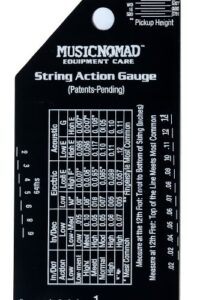
✔️MusicNomad Precision String Action Gauge Ruler
for String Height- Metric, SAE, 64ths
(MN602)
The MusicNomad MN602 String Action Gauge is a precision stainless-steel ruler
designed to help you dial in perfect string height on electric, acoustic, and bass guitars.
With easy-to-read etched markings in metric, SAE, and 64ths,
it takes the guesswork out of action setup and ensures repeatable,
pro-level results every time.
Why It’s Great:
✔️Ultra-precise etched measurements — no fading, no guessing
✔️Works for all guitars — electric, acoustic, and bass
✔️Includes action charts for fast, reliable setup targets
✔️Black-on-white contrast makes numbers easy to see under shop lighting
✔️Pocket-size stainless steel design is durable for life
✔️Perfect for accurate 12th-fret action checks on every setup you do
🧰 25Pcs Guitar Repairing Tools Kit Setup Kit
This all-in-one kit packs the essential files, wrenches,
and setup tools you’ll reach for over and over during your build.
🌟 Amazon Product Suggestion:
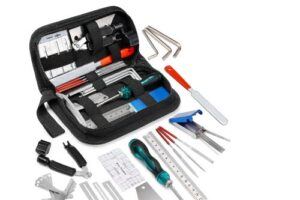
✔️25Pcs Guitar Repairing Tools Kit Setup Kit
(with Carry Bag)
This 25-piece guitar repair and setup kit gives you all the essential tools needed
for adjusting action, filing frets, setting intonation, and performing basic maintenance on
electric, acoustic, bass, or ukulele.
Compact, organized, and ideal for beginners or experienced DIY guitar techs.
Why It’s Great:
✔️ All-in-one setup kit — Includes files, gauges, rulers, hex keys, and more
✔️ Perfect for pickup, nut, and bridge adjustments
✔️ Great for electric and acoustic guitar maintenance
✔️ Comes in a compact, padded carry case — keeps everything organized
✔️ Affordable starter option for DIY luthiers
📐 Jivarrry Digital Caliper
Accurate measurements matter, and this digital caliper makes
checking thickness, spacing, and hardware fit effortless.
🌟 Amazon Product Suggestion:
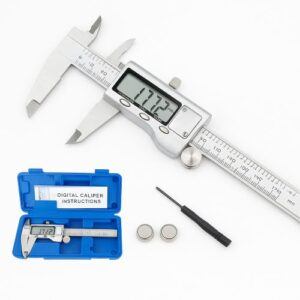
✔️ Jivarry Digital Caliper
(Stainless Steel, Large LCD, 6-Inch)
The Jivarry Digital Caliper is an affordable, accurate measuring tool that
every woodworker should keep in their shop.
With a smooth stainless-steel slide, a large easy-to-read LCD,
and instant switching between inches, millimeters, and fractions,
it makes precise measuring fast and frustration-free.
Perfect for checking board thickness, inside/outside dimensions,
dowels, hardware sizing, and fine adjustments during joinery work.
Why it’s great:
✔️Large, clear digital display
✔️Switch between inch/mm/fractions instantly
✔️ Stainless steel body for smooth, accurate travel
✔️ Measures inside, outside, depth & step values
✔️Perfect for tight-tolerance woodworking and tool setup
✔️Comes with case, batteries & mini screwdriver
🎯 Step-By-Step: How To Properly Intonate Your Electric Guitar Kit
1. Tune the Guitar to Pitch
Start by tuning the guitar to your preferred tuning
(most people use standard EADGBE).
Use your digital tuner and get every string dead-on —
Sharp or flat tuning will throw the entire intonation process off from the start.
👉 Pro Tip: Always re-check tuning after any adjustment.
Intonation and tuning chase each other like cats and laser pointers.
2. Check the 12th Fret Note vs. the Harmonic
Play the 12th-fret harmonic, then fret the string at the 12th fret.
• If the fretted note is sharp, the string length is too short.
• If it’s flat, the string length is too long.
This comparison tells you which direction your saddle needs to move.
3. Adjust the Saddle Position
Using a small screwdriver,
turn the saddle screw to move the saddle:
- Fretted note too sharp? Move the saddle back (away from the neck).
- Fretted note too flat? Move the saddle forward (toward the neck).
Make small adjustments —
a quarter turn can shift intonation more than you expect.
4. Retune and Recheck
Every time you move a saddle, the string tension changes.
Retune that string to pitch,
then re-check the harmonic vs. fretted note at the 12th fret.
Repeat until they match.
👉 Pro Tip: When the harmonic and fretted 12th-fret notes match perfectly, you’ve nailed the intonation for that string.
5. Repeat for All Six Strings
Work your way across the bridge one string at a time.
Some strings will dial in quick;
others (especially low E and G) may take a little patience.
Stay consistent: tune → compare → adjust → retune → recheck.
6. Check Intonation Up and Down the Neck
After all six strings match at the 12th fret,
play a few chords up and down the neck:
- Open chords
- Barre chords
- A few scale lines
If anything sounds slightly off,
revisit that string and tweak the saddle a hair.
7. Final Tuning and Play Test
Once everything lines up,
give the guitar one final tuning.
Play through your favorite riffs, bends, and chords —
The guitar should feel more accurate, smoother,
and more confident across the entire fretboard.
🎸 Final Thoughts…
Joe Walsh once said a guitar is like a woman —
Each one has her own personality, and you’ve gotta treat her with care
if you want her to show you what she can really do.
Intonating your electric guitar kit isn’t just a setup step —
It’s the moment your build crosses the line into a real weapon.
When those saddles lock in and every note snaps into pitch,
the guitar doesn’t just wake up…
it comes alive.
Chords hit harder.
Leads cut cleaner.
Bends scream exactly where you aim them.
Take your time,
trust your ears,
and make those adjustments like the boss of that bench —
Because yeah… you kinda are!
Every tiny tweak you make takes your kit
from “pretty good” to
“holy hell this thing RIPS,”
transforming raw parts into a guitar
with attitude, accuracy, and soul.
And remember:
A perfectly intonated guitar doesn’t just sound better…
it plays like it wants to start a fight.
Let’s rock this thing.🔥💪
Ready to Start Adjusting Your Tone?
Check out our other guides:
👉 If you’re new to guitar kits:
Start with Step-by-Step Guide To Building Your First Electric Guitar Kit
and Essential Tools Every Electric Guitar Kit Builder Should Have.
👉 If you already own a kit guitar:
Jump into How To Properly Set Up Your Electric Guitar Kit For Intonation
or Fixing Common Problems: Buzzing And Dead Frets.
👉 If you’re chasing better tone:
Head to Understanding Humbucker Vs Single Coil Pickups In Kits
or Playing With Tone Controls: Tips For Electric Guitar Kits and start experimenting.
Your Guitar, Your Build, Your Sound
You don’t need a custom shop or a tech on speed dial.
All you need is a little guidance, some patience,
and a place to go that shows you what to do next.
Come on man… You got this.
GuitarCrafts is here to help you along the way.
 Craft it. Play it. Own it!
Hi Wayne!
Just finished reading your guide to tuning an electric guitar kit and really appreciated it.
As someone who has struggled with a slightly weird DIY build in the past, your detailed step-by-step breakdown was just what I needed.
You made a potentially daunting process seem completely approachable. The “12th harmonic fret vs. fretted note” tip? Brilliant—so practical! I also loved the Strat-specific tip; my last kit had a tremolo and I wish I had known about these quirks sooner. Your emphasis on fresh strings and your patience really struck a chord with me—I’ve definitely rushed this step before and paid the price in tuning headaches.
One thing that really struck me: you called the tone the “heartbeat” of the sound. So true! After my first build, I realized that even beautiful pickups can’t save a bad tone. It’s the invisible glue that holds everything together.
Any additional wisdom on vintage-style bridges with limited saddle travel? How often do you retune in very humid climates?
Thanks for such a clear and encouraging guide. You turned a technical chore into something rewarding. The neck of my next kit will sing because of it!
Best regards,
Mitia
Wow, thank you for such a thoughtful comment! It means a lot to hear that the guide helped you, especially since DIY kits can definitely throw some curveballs. That 12th fret harmonic trick is one of those little game-changers, right? And yeah, Strat-style tremolos can be deceptively finicky, I’ve learned that lesson the hard way too.
Great questions, by the way. With vintage-style bridges, I’ve found that dialing in intonation sometimes means finding a “happy medium” rather than perfect tuning across all strings, especially if saddle travel is limited. Sometimes flipping the saddle or using compensated saddles can help. As for humid climates, I usually do a quick check and retune every time I pick up the guitar. Humidity can wreak havoc, especially on neck relief and tuning stability.
Glad to hear your next kit’s neck will sing! That’s what it’s all about. Appreciate you taking the time to write in.
Keep building!
This is such a clear and encouraging guide—setting up proper intonation truly transforms a basic build into a guitar that plays in tune across the entire fretboard. I really appreciate how you break down the process starting with fresh strings, accurate tuning, and checking the action before adjusting saddles. The step-by-step comparison between the 12th-fret harmonic and the fretted note is both simple and profoundly effective. Calling intonation the “heartbeat of your sound” is such a powerful image—it underscores how crucial this step is, even more than flashy hardware or fancy pickups.
Your special notes for Strat-style bridges are especially helpful—floating bridges do introduce unique challenges, and your method for leveling the bridge and carefully adjusting saddles is exactly the practical advice builders need. For anyone building a DIY kit, your emphasis on patience, precision, and methodical tuning can’t be overstated—it turns an intimidating final step into a rewarding one.
If there’s one thing builders often underestimate, I’d guess it’s the value of starting with brand-new strings—old ones can mask intonation issues and lead to frustration down the line. What’s one small detail in the intonation process that tends to surprise beginners the most when they first try it?
Thank you so much! I’m glad the guide made intonation approachable! Getting it right really does transform a guitar from “just playable” to something that sings across the whole fretboard.
You’re spot on about new strings, they make a huge difference in accuracy and make the whole process less frustrating. One small detail that tends to surprise beginners is just how sensitive the saddles can be. Even tiny adjustments, fractions of a millimeter, can noticeably change the intonation, and it can be eye-opening to see how precise the process needs to be. Another common surprise is how much neck relief and action affect intonation; sometimes the problem isn’t the saddles at all, but small tweaks to the neck or string height can make everything fall into place.
It’s always rewarding to see builders gain confidence with these steps. It’s those little “aha” moments that really make the effort worthwhile!
Thanks again,
~Wayne
Great post, Wayne! Intonation is one of those often-overlooked steps that can make or break a DIY guitar build. You’ve broken it down in a way that’s both practical and encouraging, which is perfect for beginners who may feel intimidated by the process. I especially appreciate how you emphasized using fresh strings and tuning accuracy before adjusting saddles—many players skip that and wonder why their guitar never sounds quite right. The section on Strat-style guitars was a solid addition too, since floating tremolo setups can be a real headache if you don’t know what you’re doing. Overall, this guide does a fantastic job of showing that intonation isn’t just about tone—it’s about playability and making the guitar truly gig-ready. With patience, the right tools, and your step-by-step approach, any builder can bring their kit to life.
Thanks so much for the thoughtful comment! I’m glad the guide came across as practical and encouraging. Intonation really is one of those steps that can make a huge difference, and it’s easy to overlook. You’re spot-on about fresh strings and accurate tuning; skipping that step is a common pitfall. I’m also happy the Strat-style section hit the mark. Floating tremolos can definitely be tricky for DIY builders. Your feedback really reinforces why I love breaking these steps down for builders of all levels.
Thanks again for taking the time to read and share your thoughts!
~Wayne