
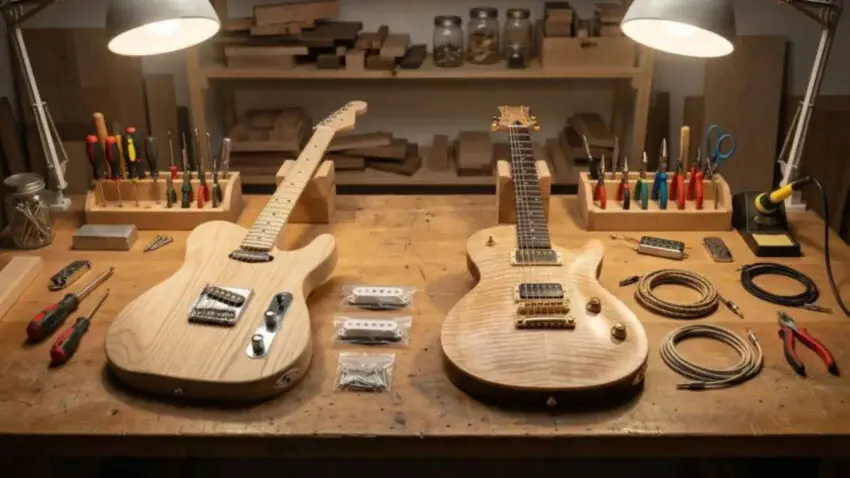
If you’re standing at the crossroads of Budget vs Premium Electric Guitar Kits: Which One To Choose?, you’re not alone. Every builder — whether it’s their first DIY kit or their fifteenth — hits this decision sooner or later.
Budget kits promise affordability and a fun learning curve, while premium kits bring upgraded tonewoods, better machining, smoother fretwork, and a more professional final result.
Knowing which one is right for your goals is the key to getting the most out of your next guitar build.
🎯 Quick Answer (No Guessing)
If you’re trying to decide between a budget or premium electric guitar kit, here’s the straight answer most beginners wish they heard upfront:
👉 Choose a budget guitar kit if:
-
This is your first-ever build
-
You’re okay learning basic fret leveling and setup
-
You want a forgiving platform where mistakes don’t feel expensive
-
You enjoy tinkering and upgrading over time
Budget kits are not “bad” guitars — they’re learning tools.
They’re affordable, mod-friendly, and a great way to build confidence without pressure.
👉 Choose a premium guitar kit if:
-
You want fewer build frustrations
-
You care about long-term playability and finish quality
-
You don’t want to replace hardware right away
-
You’re aiming for a guitar you’ll keep, gig, or record with
Premium kits cost more upfront, but they save time, rework, and upgrade expenses later.
My honest take:
If I were advising a builder face-to-face, I’d say this —
start budget if you want to learn and experiment,
go premium if you want a smoother build and a more refined final guitar.
There’s no wrong choice — only the one that best fits how you want to build.
🎸 Choosing Your Path: Budget or Premium?
If you already know which direction you’re leaning, here are the exact kits I recommend for each path:
-
👉 Affordable starter builds: Best Budget DIY Guitar Kits on Amazon
-
👉 Higher-end builds: Top Premium DIY Guitar Kits from Solo Guitars
You can still read the full breakdown below to understand why each option makes sense —
but if you’re ready to move forward, these are the kits worth starting with.
👉 If you want affordable starter kits:
Check out my guide to the Best Budget DIY Guitar Kits on Amazon

👉 If you’re looking for higher-end builds:
Explore the Top Premium DIY Guitar Kits from Solo Guitars

👉👉Double-Finger Pro Tips
👉👉 First-timers: Start with a budget kit so mistakes are cheap and stress-free.
👉👉 Want a gig-worthy instrument? Premium is the smarter choice.
👉👉 Love modding? Budget kits are the perfect playground.
👉👉 Want a showpiece with serious tone? Mahogany or flamed maple is the way to go.
🎛️ Budget vs Premium Kits — Quick Comparison
| Feature | Budget Kits | Premium Kits |
|---|---|---|
| Wood | Basswood, Paulownia | Mahogany, Alder, Ash, Maple |
| Neck | Bolt-on | Set-neck / upgraded bolt-on |
| Fretwork | Rough, needs leveling | Cleaner, smoother |
| Hardware | Basic | Upgraded |
| Finish Readiness | Needs more prep | Much smoother |
| Best For | First builds, modding | Gigging, long-term builds |
If you decide to start with a budget kit, focusing on the best electric guitar kit upgrades can dramatically improve playability and tone without the cost of a premium build.
🔨 10-Step Breakdown: Budget vs Premium Guitar Kits
1. Body Wood Quality
-
Budget kits: Frequently use basswood, paulownia, or mixed hardwoods. Lightweight, easy to shape, but not always tone-rich.
-
Premium kits: Mahogany, alder, ash, or figured maple tops. Better resonance, richer tone, cleaner grain.
Verdict: Premium wood = noticeably better sustain and tonal clarity.
2. Machining & Routing Precision
-
Budget kits: Cavities may be rougher, and neck pockets sometimes need light sanding or shimming.
-
Premium kits: Cleaner, smoother cuts, tighter tolerances, and better overall alignment.
Verdict: Premium = less frustration, cleaner fit, smoother assembly.
3. Neck Construction
-
Budget kits: Almost always bolt-on necks with basic shaping and simpler joints.
-
Premium kits: Set-neck or upgraded bolt-on options with better shaping and stronger joint stability.
Verdict: Premium necks offer more sustain and a more professional feel.
4. Fretwork Quality
-
Budget kits: Sharp fret ends, uneven crowns, and spots that require leveling.
-
Premium kits: Cleaner fret ends, more consistent leveling, and better overall finishing.
Verdict: Premium = hours saved on fretwork.
🛑 Important Reality Check for First-Time Builders
It’s easy to read comparisons like this and assume budget kits are “bad.”
They’re not.
Budget DIY guitar kits are learning platforms.
Extra sanding, fret leveling, and setup work is normal — and for many builders,
that hands-on work is part of the fun.
Premium kits reduce those extra steps, but they don’t make you a better builder overnight.
The best choice isn’t about perfection —
it’s about how much hands-on work you want to do during your build.
5. Electronics & Hardware
-
Budget kits: Generic wire, basic pots, stock pickups. Functional but not impressive.
-
Premium kits: Better hardware, smoother tuners, stronger bridges, and upgraded electronic components.
Verdict: Premium kits sound better right out of the gate.
6. Finish Readiness
-
Budget kits: Expect dents, sanding scratches, filler spots, and grain inconsistencies.
-
Premium kits: Smoother surfaces, better grain presentation, and fewer pre-finish imperfections.
Verdict: Premium makes your finish jobs look pro-level.
7. Weight & Balance
-
Budget kits: Weight varies widely because of mixed or lightweight woods.
-
Premium kits: More predictable balance thanks to quality tonewoods.
Verdict: Premium = more solid, proper-feeling guitar.
8. Upgrade Potential
-
Budget kits: Great modding platforms; you can upgrade everything as you go.
-
Premium kits: Already strong; upgrades take them to pro-level quality.
Verdict: Both win — depends on how much tinkering you want to do.
9. Playability
-
Budget kits: Good for practice and early learning.
-
Premium kits: Good enough for gigging, recording, and long-term use.
Verdict: Premium delivers a far more refined playing experience.
10. Long-Term Value
-
Budget kits: Fun, inexpensive, educational.
-
Premium kits: Hold value, last longer, and can become true keeper guitars.
Verdict: Premium kits shine when viewed as long-term investments.
🎤 Final Thoughts…
Choosing between budget and premium DIY guitar kits comes down to your goals.
Budget kits make great first builds — they’re affordable, forgiving, and fun to experiment with.
Premium kits, on the other hand, give you higher-quality wood, better machining, stronger sustain, and overall superior results.
Whether you’re building your very first project or stepping up to something worthy of the stage, the right decision is the one that matches your desired tone, finish, and long-term expectations.
Either way, every build takes you one step closer to creating your dream guitar. 🤘
Your Guitar, Your Build, Your Sound
You don’t need a custom shop or a tech on speed dial.
All you need is a little guidance, some patience, and a place to go that shows you what to do next.
Come on man… You got this.
GuitarCrafts is here to help you along the way.
 Craft it. Play it. Own it!
Ready to take your guitar passion beyond the workbench?
See how I built GuitarCrafts.com using the training at Wealthy Affiliate — you can do the same. Build Your First Website With Wealthy Affiliate (Free)

Great breakdown of budget versus premium kits!
My husband and I are currently in the middle of this exact debate regarding our church’s new electric guitar. He’s torn between a Fender and a Gibson, and I’ve been researching to help him make a decision. I really appreciate how you explained the differences in materials, craftsmanship, and tone; it helps put the price tags into perspective. I’m starting to think the choice will ultimately come down to which guitar’s sound best fits our worship style.
Out of curiosity, have you found that one brand tends to hold its value better over time?
Thanks so much! I’m glad the breakdown helped clarify the factors that go into budget vs. premium choices—it’s definitely a big decision, especially when the guitar will be part of something as important as your church’s worship music. You’re exactly right that in the end, the right choice often comes down to the sound and feel that best supports your style and atmosphere.
As for value over time, both Fender and Gibson have strong reputations and tend to hold their value well, but in general, certain Gibson models (especially Les Paul Standards and Custom Shop builds) and American-made Fenders (like the Stratocaster and Telecaster) can appreciate or maintain value a bit better, assuming they’re well cared for. That said, the “right” guitar is always the one that inspires the player the most.
Thanks again,
~Wayne
This post is another excellent addition to what has become my go-to resource for all things guitar building. Your clear comparison between budget and premium kits helps demystify that common dilemma—especially how material quality, craftsmanship, and upgrade potential can differ so drastically. I love that you emphasize value in context: budget kits are perfect for learning the ropes and personalization, while premium kits often deliver reliability and refined tone right out of the box. This site continues to strike that rare balance between expert insight and approachable advice, and I find myself returning time and again whenever I need clarity or inspiration for my next build. That said, I’m curious—have you found that certain mid-range kits offer the best balance of quality and affordability, essentially beating more expensive kits in performance? And for those looking at long-term value, are there specific premium kit features that tend to make the biggest difference in durability or resale?
Thank you for such a thoughtful and encouraging comment! I’m glad to hear the comparisons have been helpful—it’s exactly why I try to break things down in a way that works for both newcomers and seasoned builders alike.
On your question about mid-range kits: yes, there are definitely some that punch well above their price point. Often, these come from brands that have streamlined their production and offer solid tonewoods with decent hardware, leaving you room to upgrade pickups or electronics later. They can sometimes rival (or even surpass) lower-end premium kits once you’ve done a bit of fine-tuning.
For long-term value in premium kits, a few features really stand out:
Consistent neck stability (often due to better wood curing and fretwork)
Higher-grade hardware that won’t need replacing for years
Precision routing and fit that keeps everything aligned and reduces setup headaches
And if resale is in mind, recognizable brand components can add to appeal.
In short—if you want a kit that will serve you well for years without much intervention, a premium with those features is worth it. But if you enjoy upgrading and tweaking, a well-chosen mid-range kit can be a very satisfying (and cost-effective) project.
Thanks again,
~Wayne