
Skip to content
Electric Guitar Kits Logo
Menu
  • Home
  • Customization & Mods
    • Adding A Tremolo System To Your Electric Guitar Kit
    • Best Upgrades for Budget Guitar Kits (What Actually Makes a Difference)
    • D.I.Y. Fretboard Customization (Inlays, Radius & Leveling)
    • D.I.Y. Fretboard Inlays For Guitar Kits (Creative Upgrade Guide)
    • DIY Semi-hollow Guitar Kit Internal Chambers
    • D.I.Y. Custom Guitar Inlays (Step-By-Step Guide)
    • Electric Guitar Customization & Mods Guide
    • Guitar Fretboard Inlays Explained
  • Neck & Setup
    • Adjust Guitar Neck Truss Rod
    • Adjusting Action On An Electric Guitar
    • Adjusting Action And Intonation On Your Newly Built Guitar Kit
    • Comparing Bolt-on Vs Set Neck Electric Guitar Kits For Tone
    • How To Adjust Truss Rod For Neck Relief In Guitar Kits
    • How To Choose Between Neck-Through And Bolt-On Necks In Kits
    • How To Choose The Perfect Nut Material For Your Electric Guitar
    • How To Properly Set Up Your Electric Guitar Kit For Intonation
    • Refretting Your Electric Guitar Kit: When And How To Do It
    • How To Fix Buzzing Frets And Dead Notes On Your DIY Guitar Kit
    • Setting Up The Bridge And Neck On Your Electric Guitar Kit
  • Pickups & Wiring
    • Best Pickups for Guitar Kits (Budget to Pro Tone Upgrades)
    • Choosing Capacitors And Pots For Your Electric Guitar Wiring
    • Common Wiring Mistakes And How To Fix Your Electric Guitar Kit
    • Custom Wiring Patterns For Unique Guitar Sounds
    • Guide To Wiring Your Electric Guitar Kit For Optimal Performance
    • Guitar Pickups Guide: Choosing the Right Tone
    • How To Adjust Pickup Height On Electric Guitar
    • How Pickup Position Affects Electric Guitar Tone In Kits
    • How To Shield Your Guitar’s Electronics For Noise Reduction
    • Installing Pickups In Your Electric Guitar Kit: A Complete Guide
    • How To Upgrade Your Guitar Kit With Seymour Duncan & Fender Pickups
    • Step-by-step Soldering Guide For Your DIY Electric Guitar Kit
    • Best Affordable Guitar Pickups Under $100 (Budget Tone Upgrades That Deliver)
    • Understanding Humbucker Vs Single Coil Pickups In Kits
    • Ultimate Guide To Upgrading Pickups And Electronics In Guitar Kits
    • Using Tone Pots And Capacitors To Sculpt Your Sound
  • Tone & Playability
    • Adjusting Pickup Height For Optimal Sound On Your Guitar
    • Best Bluetooth Speakers for Music Lovers Who Care About Sound Quality
    • Effects Of Different Wood Types On Electric Guitar Tone
    • How Pickup Height Affects Electric Guitar Tone
    • Mastering Tone Controls on Your Electric Guitar Kit (Beginner-Friendly Guide)
    • Top DIY Electric Guitar Kits For Custom Tone
    • Wood Choices For Electric Guitar Kits: Expert Recommendations
  • Build Guides
    • Best Pro-level Electric Guitar Kit Build Guide
    • Budget Vs Premium Electric Guitar Kits: Which One To Choose?
    • Essential Tools Every Electric Guitar Kit Builder Should Have
    • Tools Needed For Building An Electric Guitar Kit
    • Beginner’s Guide: Building Your First Electric Guitar Kit Step-by-Step
    • String Changing Techniques To Protect Your Guitar
    • Best DIY Electric Guitar Kits for Custom Tone (2025 Guide)
    • Top Customizable Electric Guitar Kits For Modern Tone
    • Troubleshooting Common Issues During Electric Guitar Kit Assembly
  • Make Money Online
  • Solo Guitar Kits
    • Best Solo Guitar Kits (Complete 2025 Buying Guide)
    • Best Solo Strat-Style DIY Guitar Kits (Buying Guide)
    • Best Solo Tele-Style DIY Guitar Kits (Buying Guide)
    • Best Solo LP-Style DIY Guitar Kits (Beginner-Friendly Guide)
    • Best Solo SG-Style DIY Guitar Kits (Beginner Guide)
    • Best Solo Hollow Body Guitar Kits (Buying Guide)
    • Solo Tele Semi-Hollow DIY Kits
    • Best Solo Offset-Style DIY Guitar Kits (Buying Guide)
    • Solo Explorer & Fire-Style Guitar Kits — EXK, FBK & FVK
Menu
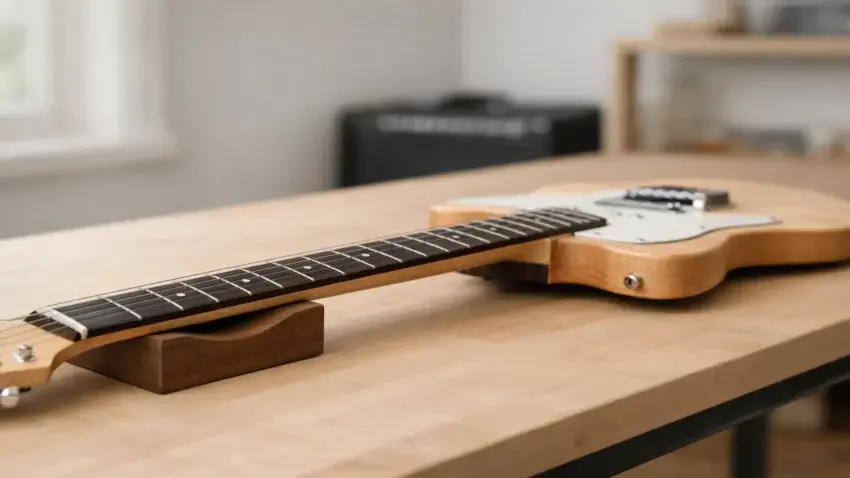
Electric guitar kit resting on a workbench with the neck supported and strings under tension, showing a straight fretboard for inspecting neck relief in a calm workshop setting.

Electric Guitar Neck Relief & Truss Rod Adjustment

Posted on January 27, 2026January 27, 2026 by Wayne

Setting up an electric guitar starts with the neck.
Before you adjust string height, touch the bridge, or think about intonation,
neck relief has to be right.

Neck relief refers to the slight forward curve built into a guitar neck to allow strings to vibrate cleanly.
Too much relief makes a guitar feel stiff and hard to play.
Too little relief can cause buzzing, dead notes, or frets choking out higher up the neck.

This guide explains how neck relief works, how truss rods control it,
and how to recognize when an adjustment is needed —
without rushing into risky changes.

If you’re building or setting up an electric guitar kit,
this is the foundation everything else depends on.


This guide is part of the complete Electric Guitar Neck & Setup Guide,
which walks through the full setup process in the correct order —
from neck relief and action to intonation and long-term playability.


What Is Guitar Neck Relief?

Neck relief is the intentional, slight bow in a guitar neck that gives strings room to vibrate.
Even a perfectly built neck is not meant to be dead straight under string tension.

When strings vibrate, they move in an oval pattern.
The widest part of that vibration happens around the middle of the string length.
Neck relief provides clearance in that area so notes ring cleanly without buzzing.

Think of neck relief as controlled flexibility, not a flaw.


Why Neck Relief Comes First in Setup

Every other setup adjustment depends on the neck being correct.

If neck relief is off:

  • Lowering action won’t fix buzzing

  • Raising saddles won’t solve dead frets

  • Intonation adjustments won’t hold

  • Playability will feel inconsistent

That’s why professional setups always start at the neck and work outward.

Relief first.
Action second.
Intonation last.

Skipping this order leads to frustration and unnecessary adjustments later.


How Truss Rods Control Neck Relief

The truss rod is a metal rod installed inside the neck.
Its job is to counteract string tension and stabilize the neck over time.

When adjusted:

  • Tightening the truss rod reduces forward bow

  • Loosening the truss rod allows more relief

Most electric guitars use either:

  • Single-action truss rods, which adjust in one direction

  • Dual-action truss rods, which can add or remove relief more actively

You don’t need to know which type you have to understand the basics.
What matters is knowing what the truss rod is meant to do — and what it is not.


What a Truss Rod Can and Cannot Fix

A truss rod can:

  • Correct normal forward bow

  • Reduce excess relief

  • Stabilize the neck under string tension

A truss rod cannot:

  • Fix twisted necks

  • Repair warped fretboards

  • Correct uneven frets

  • Solve all buzzing issues

If an adjustment feels forced or produces no change after reasonable turns,
that’s a sign to stop — not push harder.


Signs Your Neck Relief Needs Attention

You don’t need measuring tools to notice common warning signs.

Neck relief may be off if:

  • Strings feel unusually stiff or loose

  • Buzzing appears across multiple frets

  • Notes choke out around the middle of the neck

  • Action adjustments don’t behave as expected

  • Tuning stability feels inconsistent

These symptoms don’t always mean the truss rod needs turning —
but they always mean the neck should be checked first.


How Much Adjustment Is Safe?

Truss rod adjustments should always be:

  • Small

  • Gradual

  • Intentional

Quarter-turns are common.
Eighth-turns are safer when you’re unsure.

Large, fast adjustments increase the risk of damage
and make it harder to understand what actually changed.

If you ever feel resistance that seems abnormal, stop.
Truss rods should turn smoothly with steady pressure.


Wood Movement Is Normal (Especially in Kits)

Electric guitar necks are made of wood, and wood reacts to:

  • Humidity changes

  • Seasonal temperature shifts

  • String tension changes

That means neck relief can drift over time —
especially on new builds and kits that haven’t fully settled yet.

Needing a minor adjustment after a few weeks or months is normal.
Constant large adjustments are not.

Understanding this helps prevent over-correcting a neck that simply needs time to stabilize.


When Not to Adjust the Truss Rod

There are moments when adjusting the truss rod is the wrong move.

Do not adjust if:

  • You’re chasing a single buzzing fret

  • The neck shows visible twisting

  • Frets are uneven or lifting

  • You’re unsure which direction to turn

In these cases, the problem often lies elsewhere — and forcing the truss rod won’t help.


What Comes After Neck Relief?

Once neck relief is set correctly, the rest of the setup process becomes predictable and controllable.

The next step is dialing in string height and action,
where comfort and playability are refined without fighting the neck.


Once neck relief is set correctly,
the next step is adjusting string height and action to dial in
comfort and playability without fighting the neck.


Take Your Time — You’re Doing It Right

Neck adjustments aren’t about speed.
They’re about understanding what the guitar is telling you.

A calm approach, small changes,
and patience will get better results than chasing perfection in one session.

You don’t need a custom shop or decades of experience —
just a clear process and the confidence to move step by step.

GuitarCrafts is here to help you through each stage.


🎸 Craft it. Play it. Own it. 🎸


Ready to take your guitar passion beyond the workbench?

See how I built GuitarCrafts.com using the training at Wealthy Affiliate — you can do the same.
👉👉 Build Your First Website With Wealthy Affiliate (Free)

Wealthy Affiliate Internet Marketing University Banner


Leave a Reply Cancel reply

Your email address will not be published. Required fields are marked *

Learn to make money in the comfort of your own home!

  • Facebook
  • Pinterest
  • YouTube

Recent Posts

  • How To Make Money With Guitar Kits Online
  • Can Beginners Make Money With Guitar Kits Online?
  • What Do You Need To Start A Guitar Website?
  • How Long Does It Take To Make Money With Guitar Kits Online?
  • Can You Make Money With Guitar Kits Online?
  • About Me...
  • Affiliate Disclosure
  • Best Solo Guitar Kits (Complete 2025 Buying Guide)
  • Best Solo Hollow Body Guitar Kits (Buying Guide)
  • Best Solo LP-Style DIY Guitar Kits (Beginner-Friendly Guide)
  • Best Solo Offset-Style DIY Guitar Kits (Buying Guide)
  • Best Solo SG-Style DIY Guitar Kits (Beginner Guide)
  • Best Solo Strat-Style DIY Guitar Kits (Buying Guide)
  • Best Solo Tele-Style DIY Guitar Kits (Buying Guide)
  • Build Your Own Dream Guitar Kit (Without Feeling Overwhelmed)
  • GuitarCrafts Homepage
  • How I Built a Money-Making Guitar Website With Wealthy Affiliate (Honest Review)
  • Privacy Policy
  • Solo Explorer & Fire-Style Guitar Kits — EXK, FBK & FVK
  • Solo Guitars Review (2025): Are Their DIY Guitar Kits Worth It?
  • Solo Tele Semi-Hollow DIY Kits

Archives

  • April 2026
  • March 2026
  • February 2026
  • January 2026
  • December 2025
  • November 2025
  • September 2025
  • August 2025
  • July 2025

Categories

  • Build Guides
  • Buying Guides
  • Customization & Mods
  • Make Money With Guitar Kits
  • Neck & Setup
  • Pickups & Wiring
  • Tone & Playability
  • Uncategorized
© 2026 My Electric Guitar Kits Site | Powered by Superbs Personal Blog theme