
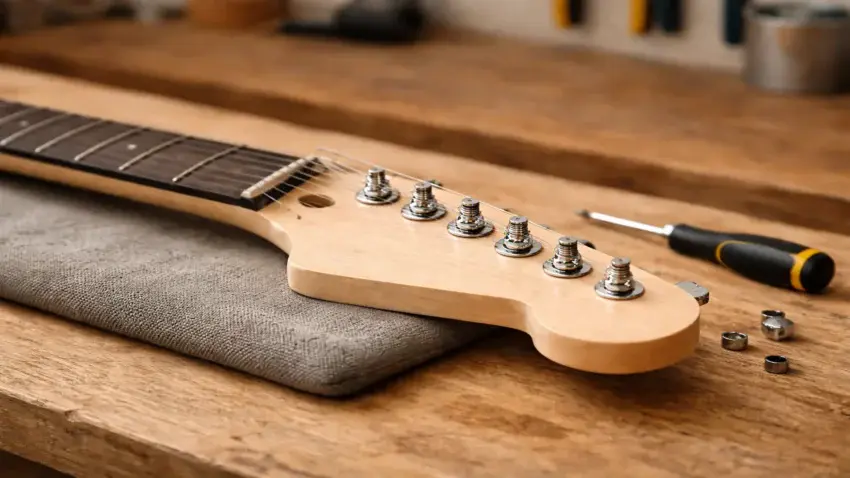
If a guitar won’t stay in tune, nothing else matters.
Most frustration with budget guitar kits doesn’t come from bad pickups or cheap wood —
it comes from inconsistent tuning.
Strings drift sharp or flat, bends don’t return to pitch, and setup work never quite holds.
That’s why tuners are the first upgrade that actually makes a difference.
This guide focuses on what really matters when choosing tuners for budget guitar kits —
not hype, not brand loyalty, and not features that don’t solve real problems.
The goal is simple: help you choose tuners that tune smoothly, hold pitch,
and stop fighting you while you play.
Why Tuners Are the First Upgrade That Matters
Tuning stability sets the ceiling for everything that comes after it.
If the tuners slip, bind, or respond inconsistently:
-
You can’t set intonation accurately
-
You can’t judge pickup changes reliably
-
You end up chasing problems that aren’t actually tone-related
That’s why tuners come before electronics, shielding, or pickups in a smart upgrade order.
On many budget guitar kits, stock tuners fail in predictable ways:
-
Gears feel loose or uneven
-
Small adjustments overshoot or lag
-
Strings don’t return to pitch after bends
Even when they technically work, they make tuning feel imprecise and frustrating.
Upgrading tuners doesn’t change how the guitar sounds — it changes how trustworthy it feels.
Once the guitar tunes smoothly and holds pitch, every other adjustment becomes easier and more meaningful.
That’s why, if you’re only upgrading one thing on a budget kit, this is where you start.
Why Stock Kit Tuners Fail (and How to Spot the Problem)
Most stock tuners included with budget guitar kits aren’t broken —
they’re just built to meet a price point.
They technically turn.
They technically hold strings.
But under real playing conditions, their weaknesses show up quickly.
The most common problems come from inconsistent gearing and poor internal tolerances,
not from how carefully you tune.
Common signs your tuners are the problem
If you notice any of the following, the tuners are likely holding the guitar back:
-
Uneven tuning response
Small turns sometimes do nothing, then suddenly jump sharp or flat. -
Poor return-to-pitch after bends
You tune accurately, bend a string, and it doesn’t come back to pitch. -
Slipping under normal playing
The guitar slowly drifts out of tune even without aggressive playing. -
Loose or vague feel
The tuning key turns, but it doesn’t feel connected or precise.
These issues make tuning feel unpredictable, even when you’re doing everything “right.”
Why setups and strings don’t fully fix this
A proper setup and fresh strings are important —
but they can’t compensate for tuners that respond inconsistently.
If the gears inside the tuner:
-
Have excess play
-
Don’t mesh smoothly
-
Or bind during rotation
No amount of setup work will make tuning feel stable.
This is why many builders assume their guitar has multiple problems,
when in reality the tuners are the single bottleneck.
The key takeaway
If tuning feels imprecise or unpredictable, the issue is often mechanical — not technique-related.
Recognizing this early prevents wasted time, repeated setups, and frustration.
Once tuning feels smooth and repeatable, everything else about the build becomes easier to judge.
What Actually Makes a Tuner “Good” on a Budget Guitar Kit
A good tuner isn’t defined by hype, brand names, or flashy features.
On a budget guitar kit, a good tuner is one that responds predictably every time you touch it.
That comes down to a few practical qualities that matter far more than marketing specs.
Smooth, consistent gearing (more important than gear ratio)
High gear ratios look impressive on paper, but consistency matters more than numbers.
A good tuner:
-
Moves the string immediately when you turn the key
-
Responds evenly through the full rotation
-
Doesn’t lag, jump, or bind
When gearing is smooth and consistent, tuning feels controlled instead of delicate.
Solid internal tolerances
Loose internal tolerances are what cause:
-
Vague tuning feel
-
Micro-slippage
-
Drift after tuning
Better tuners are built with tighter tolerances, which means:
-
Less internal play
-
Better connection between your hand and the string
-
More confidence during fine adjustments
You feel this immediately — even before you play a note.
Stable mounting and proper fit
A tuner can be well-made and still perform poorly if it doesn’t fit the headstock correctly.
Good tuners:
-
Sit flush against the headstock
-
Don’t flex or twist under string tension
-
Use mounting hardware that stays tight
Stability at the headstock is critical. Any movement here translates directly into tuning instability.
Reliability over features
Features like locking mechanisms or ultra-high ratios can be helpful — but only after the basics are solid.
On a budget guitar kit, the priority should always be:
-
Smooth tuning feel
-
Predictable response
-
Long-term reliability
A simple, well-built tuner outperforms a feature-loaded tuner that’s inconsistent.
The practical rule
If a tuner feels smooth, responds immediately, and holds position under tension, it’s doing its job — regardless of branding.
Once these fundamentals are in place, tuning stops being something you fight and starts being something you trust.
Tuner Types Explained (Sealed, Vintage-Style, and Locking)
Not all tuners solve the same problems.
Understanding the type matters more than chasing features.
On budget guitar kits, the goal is reliability and fit — not trends.
Sealed tuners (most common upgrade)
Sealed tuners are the most common and reliable choice for budget kits.
Why they work well:
-
Enclosed gears stay protected from dust and wear
-
Consistent feel across all tuners
-
Generally more durable over time
For most builders, sealed tuners offer the best balance of:
-
Smooth tuning
-
Stability
-
Ease of installation
This is usually the safest, lowest-risk upgrade.
Vintage-style tuners (when feel and fit matter)
Vintage-style tuners aren’t worse — they’re just different.
They can work well when:
-
The headstock is drilled for vintage posts
-
You prefer lighter tuner weight
-
The guitar is styled around traditional designs
However, quality matters more here.
Low-grade vintage tuners often exaggerate the same problems found in stock kit hardware.
If you choose this style, build quality is critical.
Locking tuners (helpful, but often misunderstood)
Locking tuners don’t magically fix tuning problems.
What they actually do:
-
Speed up string changes
-
Reduce excess string wraps
-
Improve consistency when paired with a good nut
What they don’t do:
-
Fix poor nut slots
-
Correct bad gearing
-
Compensate for loose internals
On a budget kit, locking tuners only make sense after the basics are handled.
They’re a convenience upgrade — not a cure.
The practical rule
Choose the tuner type that fits your headstock cleanly and prioritizes smooth, consistent response.
Sealed tuners work for most builds.
Vintage-style tuners work when chosen carefully.
Locking tuners help after fundamentals are right.
Good Tuner Choices for Budget Guitar Kits
(What to Look For Without Overpaying)
At this point, you don’t need the best tuners ever made.
You need tuners that work consistently, fit correctly, and don’t introduce new problems.
That’s where many builders overspend — chasing features instead of function.
What a “good choice” actually looks like
A good tuner for a budget guitar kit usually has:
-
Sealed construction with smooth, even rotation
-
Consistent feel across all six tuners
-
Standard mounting dimensions that match common kit headstocks
-
A reputation for reliability, not novelty
You should be paying for build quality, not marketing language.
Where you get the most value
For most budget kits, the sweet spot is:
-
Mid-priced sealed tuners
-
Simple, proven designs
-
No unnecessary mechanisms
These tuners:
-
Tune smoothly
-
Hold pitch under normal playing
-
Last far longer than stock kit hardware
They also avoid the common trap of paying extra for features you won’t actually benefit from yet.
When paying more does make sense
Spending a bit more can be justified if:
-
The guitar will be played regularly
-
You’re tired of constant retuning
-
You want tuning to feel effortless instead of delicate
At that point, the improvement is felt every time you pick up the guitar — not just during setup.
When paying more doesn’t make sense
Higher price does not automatically mean better results if:
-
The nut isn’t cut properly
-
The tuners don’t fit the headstock cleanly
-
You’re expecting tuners to fix unrelated problems
A well-chosen mid-range tuner will outperform an expensive tuner that’s poorly matched to the build.
The practical rule
Buy the best-built tuner that fits your headstock cleanly — not the one with the most features.
If tuning feels smooth, adjustments are predictable, and pitch holds during playing, you’ve made the right choice.
That’s success — not a logo on the back of the headstock.
Common Mistakes When Upgrading Tuners
(and How to Avoid Them)
Most tuning problems don’t come from choosing the wrong tuners —
they come from expecting tuners to fix problems they aren’t responsible for.
Avoiding these common mistakes saves time, money, and frustration.
Expecting tuners to fix nut problems
If strings bind at the nut, even the best tuners will feel inconsistent.
Before blaming the tuners, make sure:
-
Nut slots are properly cut
-
Strings move smoothly while tuning
-
There’s no audible “ping” when tuning up
Tuners and nut work together. One can’t compensate for the other.
Choosing tuners that don’t fit the headstock
Poor fit causes:
-
Movement under tension
-
Installation headaches
-
New tuning issues that weren’t there before
Always confirm:
-
Post diameter
-
Mounting screw pattern
-
Headstock thickness
A well-built tuner that fits properly will outperform a better tuner that doesn’t.
Overpaying for features you don’t need
Locking mechanisms and ultra-high gear ratios don’t automatically improve tuning stability.
If the basics aren’t right, those features won’t help — and may even complicate things.
Replacing tuners before addressing setup basics
Fresh strings, proper stringing technique, and basic setup still matter.
Tuners improve consistency, not fundamentals.
How This Fits Into the Full Upgrade Order
Tuners belong at the very start of a smart upgrade path because everything else depends on tuning stability.
Once the guitar:
-
Tunes smoothly
-
Holds pitch
-
Returns to pitch after bends
You can confidently move on to electronics reliability, noise control, and tone shaping —
knowing you’re building on a solid foundation.
If you’re following a structured upgrade approach, this tuner upgrade supports
Step 1: Tuning Stability in the complete upgrade order outlined in
Best Upgrade Order for Budget Guitar Kits (What to Change First).
Final Takeaway…
A good tuner upgrade doesn’t make a guitar sound better —
it makes everything else work better.
When tuning feels smooth and predictable,
the guitar stops fighting you and starts responding the way it should.
That’s when upgrading a budget guitar kit becomes enjoyable instead of frustrating.
Ready to Keep Improving Your Guitar?
Check out our other guides:
 If you’re new to guitar kits:
Start with Step-by-Step Guide To Building Your First Electric Guitar Kit and Essential Tools Every Electric Guitar Kit Builder Should Have.
If you already own a kit guitar:
Jump into How To Properly Set Up Your Electric Guitar Kit For Intonation or Fixing Common Problems: Buzzing And Dead Frets.
If you’re chasing better tone:
Head to Understanding Humbucker Vs Single Coil Pickups In Kits or Playing With Tone Controls: Tips For Electric Guitar Kits and start experimenting.
Your Guitar, Your Build, Your Sound
You don’t need a custom shop or a tech on speed dial.
All you need is a little guidance, some patience, and a place to go that shows you what to do next.
Come on man… You got this.
GuitarCrafts is here to help you along the way.
 Craft it. Play it. Own it!
Ready to take your guitar passion beyond the workbench?
See how I built GuitarCrafts.com using the training at Wealthy Affiliate — you can do the same.
Build Your First Website With Wealthy Affiliate (Free)
