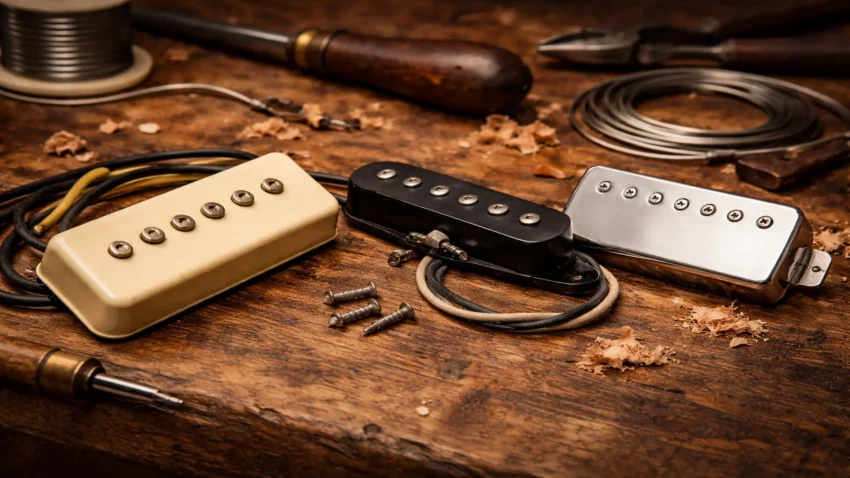
P90 pickups often confuse new guitar players.
At first glance, they look similar to humbuckers
because of their size and strong output.
But technically,
P90 pickups are actually a type of single-coil pickup.
Understanding how P90 pickups are designed —
and why they sound different from both single coils and humbuckers —
can help you choose the right pickup for your guitar tone.
What Are P90 Pickups?
P90 pickups were first introduced by Gibson in the mid-1940s
and quickly became one of the most popular electric guitar pickup designs.
Although they use a single coil of wire,
the coil itself is much wider than a traditional Fender-style single coil.
This wider coil produces a stronger signal and a thicker sound.
Because of this design,
P90 pickups deliver a tone that sits between a traditional single coil and a humbucker.
P90 pickups are known for:
✔ Thick midrange response
✔ Gritty vintage tone
✔ Higher output than standard single coils
✔ Dynamic response to picking attack
Why P90 Pickups Are Still Considered Single Coils
Despite their size and power,
P90 pickups still use one coil of wire wrapped around magnets.
That means they function exactly like other single-coil pickups
when it comes to how they capture string vibration.
Because they only use one coil,
P90 pickups can still produce the familiar single-coil hum
that occurs with many vintage pickup designs.
How P90 Pickups Compare To Humbuckers
Humbucker pickups were created in the 1950s to
eliminate the electrical hum produced by single-coil pickups.
They achieve this by using two coils wired together,
which cancel out unwanted noise.
Because of this design, humbuckers typically produce:
✔ Higher output
✔ Thicker low end
✔ Less electrical noise
While P90 pickups are louder than most traditional single coils,
they do not cancel hum the way humbuckers do.
How P90 Pickups Compare To Traditional Single Coils
Compared to traditional Fender-style single coils,
P90 pickups sound:
✔ Warmer
✔ Thicker
✔ More aggressive
Traditional single coils,
however, still offer:
✔ Brighter tone
✔ Sharper attack
✔ More sparkling clean sounds
Both pickup styles are widely used across many genres of music.
Which Pickup Style Is Right For You?
If you like the clarity of single coils but want more punch and midrange,
P90 pickups are a great option.
If you prefer bright clean tones and classic twang,
traditional single coils may be a better choice.
And if you want maximum output with minimal noise,
humbuckers remain the most powerful pickup design.
👉 If you want a deeper comparison between these two classic pickup styles,
check out our guide on P90 vs Single Coil Pickups: What’s the Difference?.
👉 You can also see how P90 pickups stack up against another popular design
in our article P90 vs Humbucker Pickups: Which Is Better For Your Guitar Tone?.
👉 For a broader comparison between the two most common pickup styles,
see our guide on Single Coil vs Humbucker Pickups: Which Is Better?.
Final Thoughts…
P90 pickups may look similar to humbuckers,
but they are technically a type of single-coil pickup.
Their wider coil design gives them a unique sound that
blends the brightness of single coils with the punch and
grit that many rock and blues players love.
For guitar builders and players alike,
experimenting with different pickup types can dramatically
change the character of an instrument.
Ready to Start Adjusting Your Tone?
Check out our other guides:
 If you’re new to guitar kits:
Start with Step-by-Step Guide To Building Your First Electric Guitar Kit
and Essential Tools Every Electric Guitar Kit Builder Should Have.
If you already own a kit guitar:
Jump into How To Properly Set Up Your Electric Guitar Kit For Intonation
or Fixing Common Problems: Buzzing And Dead Frets.
If you’re chasing better tone:
Head to Understanding Humbucker Vs Single Coil Pickups In Kits
or Playing With Tone Controls: Tips For Electric Guitar Kits and start experimenting.
Your Guitar. Your Build. Your Sound.
Your next great guitar build could begin today.
All you need is the right tools, a little patience,
and a passion for great tone.
Come on man… You got this.
GuitarCrafts is here to help you along the way.
 Craft it. Play it. Own it!