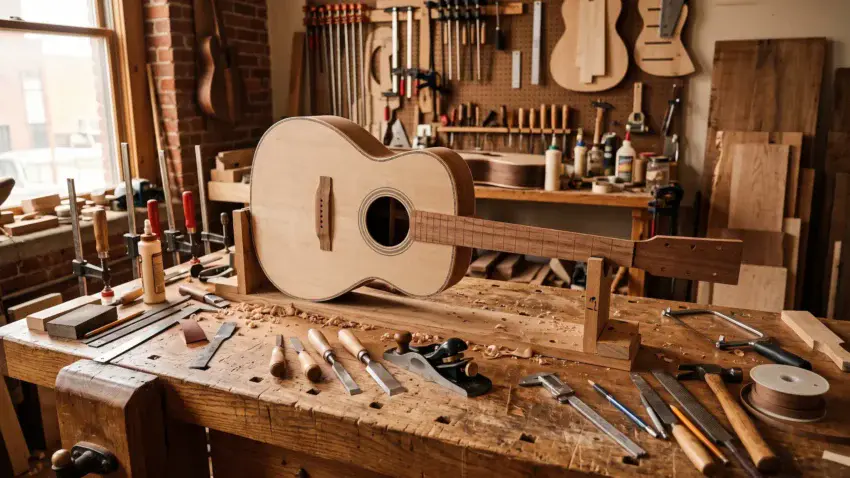
Building an acoustic guitar takes tools — but probably not as many as you think.
The tools you need will depend on how you decide to build.
An acoustic guitar kit can let you skip some of the more specialized work, while a scratch build may have you bending sides, shaping braces, thicknessing wood, and making parts from the ground up.
That doesn’t mean you need to fill your workshop before you start.
Some tools are essential.
Some make the job easier.
And plenty of others can wait until you actually need them.
The goal isn’t to own every luthier tool ever made.
It’s to have the right tool for the job in front of you.
Before you worry about specialized luthier tools, start with the basics.
A good set of chisels, sanding blocks, files, clamps, steel rulers, and measuring tools will follow you through almost every stage of the build.
You’ll use them to shape wood, fit parts, check your work, and make the small adjustments that help everything come together.
You may already own some of these tools.
And if you’ve built an electric guitar kit before, there’s a good chance part of your tool collection can follow you into the acoustic side of the workshop.
You don’t need to buy everything at once.
Start with the tools you’ll reach for again and again.
👉 Still wondering if you’re ready to take on the whole project?
Start with Can I Really Build an Acoustic Guitar? and see what your first build really takes.
📏 Measuring Tools Matter More Than You Think
A guitar can look beautiful and still be frustrating to play if the measurements are off.
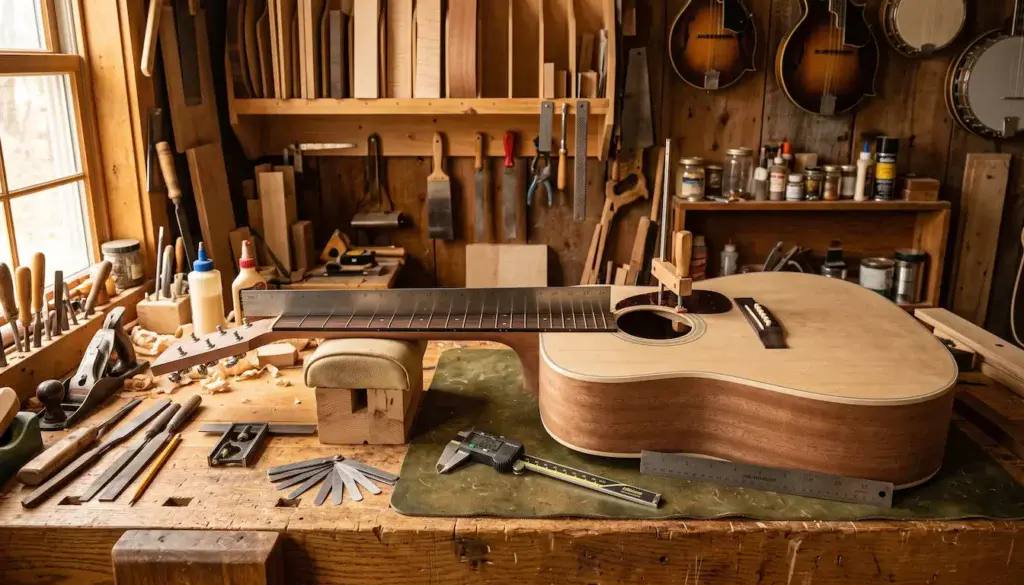
Straightedges, steel rulers, feeler gauges, calipers, and a good square help you check everything from wood thickness and fret spacing to neck alignment and final setup.
You don’t need to measure every piece of wood ten times.
But there are moments in a guitar build when a small difference can become a much bigger problem later.
Good measuring tools help you catch those problems while they’re still easy to fix.
The closer you get to the finished guitar, the more those little measurements matter.
Jivarry Digital Caliper
Small measurements can make a big difference when you’re building an acoustic guitar.
The Jivarry Digital Caliper gives you a quick, reliable way to check parts before a small mistake becomes a much bigger problem.
The Jivarry Digital Caliper makes it easy to measure wood thickness, fretwire, nut and saddle material, hardware, and other small components throughout the build. Its digital display gives you clear readings without slowing down the work.
Why It’s Great
✓ Clear digital readings ✓ Measures small parts precisely ✓ Useful throughout the build ✓ A tool you’ll use again and again
🎸 Small Measurements Make a Big Difference
Reliable measuring tools help catch small problems before they become much harder to fix.
🪚 Shaping Tools Bring the Guitar to Life
An acoustic guitar is full of curves, angles, and small details that need to be shaped by hand.
Chisels, files, rasps, small hand planes, and sanding blocks help you fit joints, shape braces, smooth edges, and slowly bring each part where it needs to be.
This is where patience matters.
It’s usually easier to remove a little more wood than to put some back after you’ve gone too far.
Take your time.
Check your work often.
Let the tool do the work.
Good shaping isn’t about working fast.
It’s about knowing when to stop.
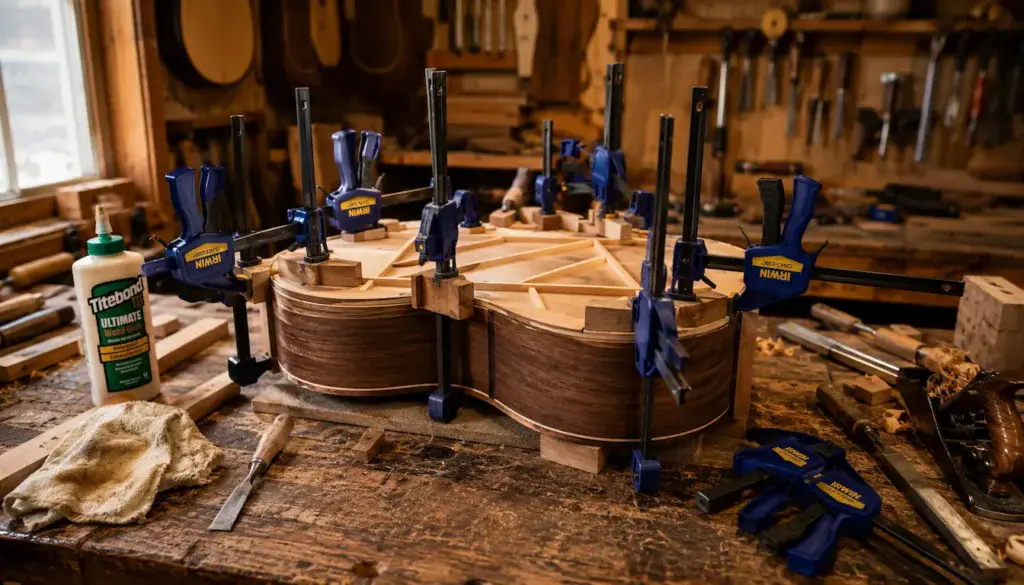
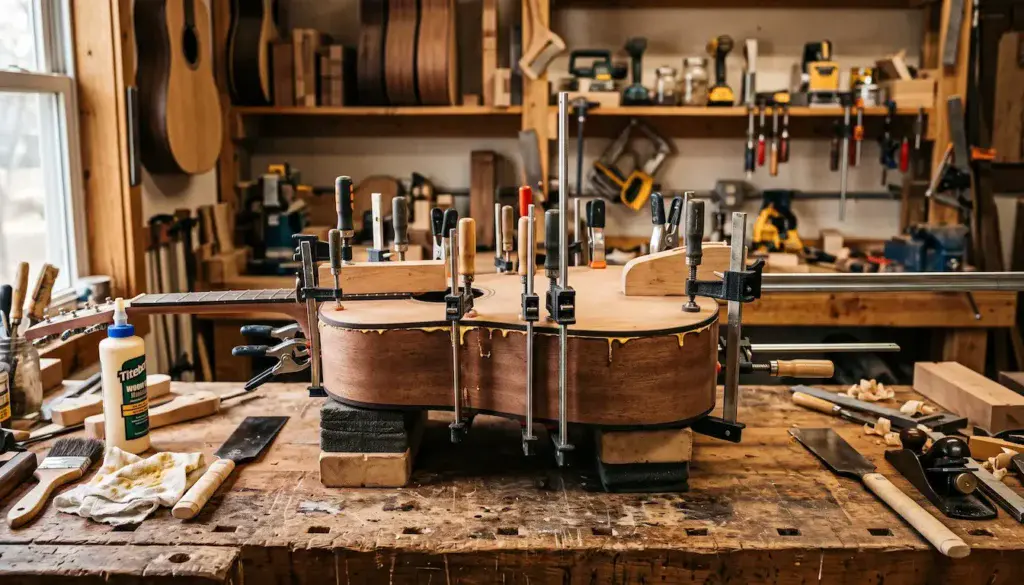
🗜️ You’ll Need More Clamps Than You Think
Clamps are one of those tools you can never seem to have enough of.
You’ll use them to hold parts in place while glue dries, keep joints tight, secure the body during assembly, and stop pieces from moving when they need to stay exactly where you put them.
But not every job needs the same kind of clamp.
Small clamps work well for braces and delicate parts.
Longer clamps may be needed for the body and neck.
Some jobs may even call for homemade clamping jigs made specifically for guitar building.
You don’t have to buy every clamp in the store.
But once the glue comes out, you’ll want the right ones close by.
Because glue-up is a terrible time to realize you’re two clamps short.
IRWIN Quick-Grip 6″ Mini Bar Clamp Set
When the glue comes out, having a few extra clamps within reach can make all the difference.
The IRWIN Quick-Grip Mini Bar Clamps give you four dependable clamps for holding smaller parts and everyday glue-ups securely in place.
The IRWIN Quick-Grip 6-Inch Mini Bar Clamp 4-Pack gives you compact, one-handed clamping power for braces, cauls, small parts, and other jobs around the acoustic guitar build. Their 6-inch size makes them easy to position without crowding the workbench.
Why It’s Great
✓ Four clamps in one pack ✓ Easy one-handed operation ✓ Great for smaller glue-ups ✓ Useful beyond guitar building
🎸 There’s Always Room for One More Clamp
The right clamps keep everything exactly where it belongs when the glue comes out.
🧱 Jigs Make Difficult Jobs Repeatable
Some guitar-building jobs are much easier when you’re not trying to hold everything in place by hand.
A good jig can help you keep parts aligned, guide a tool, hold the guitar body securely, or repeat the same cut or shape more accurately.
Some jigs can be bought.
Others are simple enough to build yourself.
And that’s part of the fun.
As your guitar-building skills grow, you may find yourself building tools and jigs almost as often as you build guitars.
Sometimes the best tool for the job is the one you make yourself.
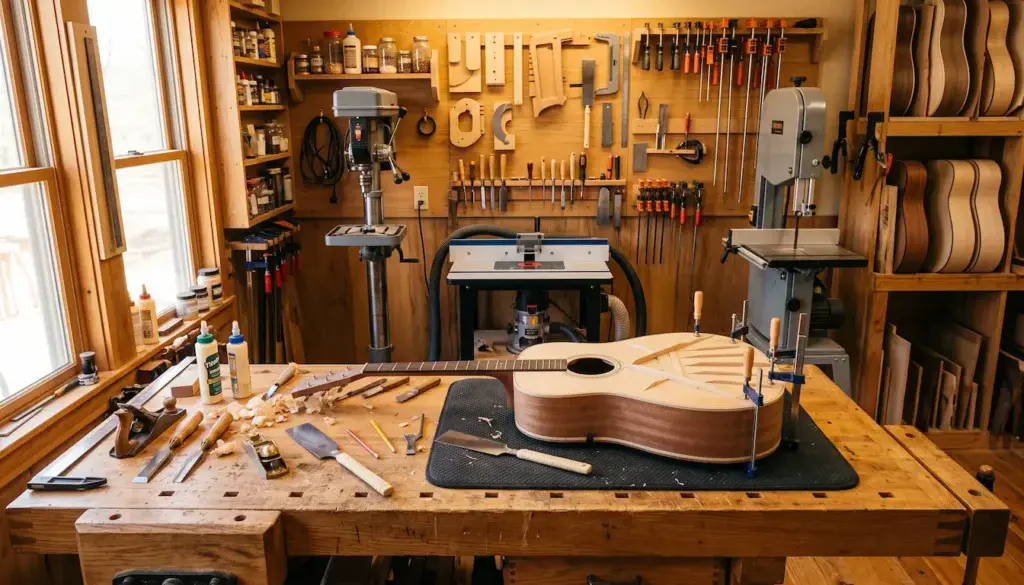
🔌 Do You Need Power Tools?
Not necessarily.
Plenty of guitar-building work can be done with hand tools, especially if you’re starting with a kit.
But power tools can save time and make some jobs easier.
A drill, router, bandsaw, drill press, or thickness sander may become useful as you take on more of the work yourself.
The key is knowing when a power tool actually helps.
Faster isn’t always better when you’re working with thin wood and small parts that are easy to damage.
Use power tools to save time—not to replace careful work.
🎸 Hand Tools or Power Tools? You’ll Probably Use Both
Power tools can save time, but careful handwork still plays a big part in building an acoustic guitar.
🪵 Some Tools Depend on How You Build
The tool list changes depending on the path you choose.
If you’re building from a kit, some of the hardest jobs may already be done.
The sides may be bent, the wood may be thicknessed, and the major parts may already be cut to shape.
A scratch build asks more from your workshop.
You may need tools for bending sides, thicknessing wood, cutting parts, shaping braces, and building the forms and jigs that hold everything together.
That’s why there’s no single tool list that works for every builder.
The more of the guitar you make yourself, the more tools you’ll need along the way.
You don’t need the most expensive version of every tool in the workshop.
Some tools only come out for one or two jobs.
Others will be in your hands through almost every build.
Those are the ones worth paying attention to.
A good chisel that holds an edge, a straightedge you can trust, a square that is actually square, and measuring tools that give you consistent results can save a lot of frustration.
Buy quality where accuracy and control matter most.
Save money where a simple tool will do the job just fine.
Spend more on the tools you’ll trust again and again.
🧰 What About Specialty Luthier Tools?
Specialty tools can make certain jobs easier, but that doesn’t mean you need to buy all of them before your first build.
You’ll find tools made for fretwork, bridge placement, soundhole cutting, side bending, binding, neck fitting, and just about every other part of building a guitar.
Some are worth owning.
Others may only make sense after you’ve built a few guitars and know which jobs you want to make easier.
Start with the problem in front of you. Then decide whether a specialty tool is the best solution.
Don’t build your tool collection faster than you build your skills.
🔄 You Can Add Tools as Your Skills Grow
Your first build doesn’t need to start with a fully equipped luthier’s workshop.
Buy the tools you need for the job in front of you.
Use them.
Learn what they can do.
Then add the next tool when the build gives you a reason to.
Over time, your workshop will grow naturally.
You’ll discover which tools you reach for constantly, which ones make difficult jobs easier, and which ones you probably could have lived without.
That’s a much better way to build a workshop than buying everything at once.
Let the guitars you build decide which tools you buy next.
👉 Still deciding how you want to build your first acoustic guitar?
Compare an Acoustic Guitar Kit or Scratch Build and choose the path that fits you best.
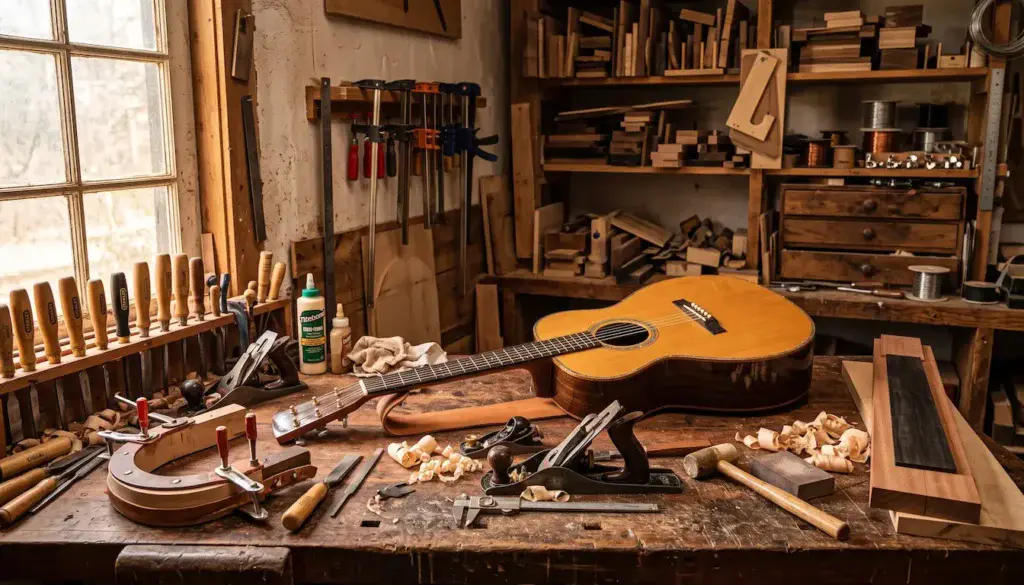
🎸 Build the Guitar and the Workshop Will Follow
Add tools as you need them, and your workshop will grow right along with your skills.
🏁 Final Thoughts…
You don’t need a workshop full of expensive tools to start building an acoustic guitar.
You need a few reliable basics, the right tools for the jobs ahead, and the patience to add more as your skills grow.
A kit may let you start with less.
A scratch build will ask more from your workshop.
Either way, there’s no reason to buy every tool before you know why you need it.
Start with what you have.
Add what the build requires.
And over time, you may look around and realize you didn’t just build an acoustic guitar.
You built a workshop along with it.
Your Guitar, Your Build, Your Sound
You don’t need a custom shop or a tech on speed dial.
All you need is a little guidance, some patience, and a place to go that shows you what to do next.

 Amazon Product Suggestion: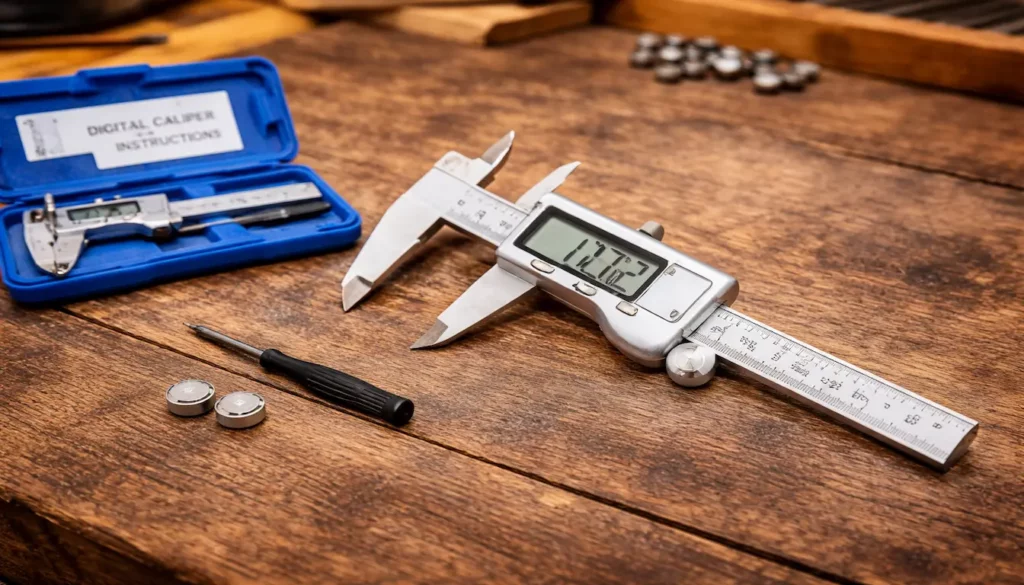
 Your Guitar, Your Build, Your Sound