Building an acoustic guitar can look overwhelming when you see the finished instrument and try to imagine everything that happened before the strings went on.
But the process becomes much easier to understand when you break it into a series of smaller, carefully connected stages.
From choosing and preparing the wood to building the body, fitting the neck, applying the finish, and finally hearing that first chord, every step builds on the one before it.
This guide walks through the entire acoustic guitar building process so you can see the road ahead before you ever make the first cut.
👉 Wondering how much time all of this actually takes?
Read How Long Does It Take to Build an Acoustic Guitar? for a realistic look at the timeline from your first day at the workbench to the final setup.
🪵 Step 1: Choose and Prepare the Tonewood
Every acoustic guitar begins with the wood.
The soundboard, back, sides, neck, fingerboard, and bridge each have different jobs, so the wood for each part must be chosen and prepared with care.
Before construction begins, the wood needs to be properly dried, stable, and brought into the workshop environment.
The pieces are then inspected, measured, joined where necessary, and brought closer to their final thickness.
This is where the pile of raw wood begins its transformation.
Nothing looks much like a guitar yet — but every decision made here affects everything that comes next.
🪚 Step 2: Build and Brace the Soundboard
The soundboard is the vibrating heart of an acoustic guitar.
After the two halves are joined and brought to the proper thickness, the soundhole is cut and the rosette is installed.
Braces are then shaped, fitted, and glued to the inside of the top.
These small pieces of wood must provide enough strength to resist string tension while still allowing the soundboard to move freely.
This is one of the most important balancing acts in the entire build.
The soundboard must be strong enough to survive — but light enough to sing.
🌀 Step 3: Bend the Sides Into Shape
The flat side pieces must be carefully bent into the curves that give the acoustic guitar its familiar shape.
Heat and moisture make the wood flexible enough to bend, but the process still requires patience and control.
Once bent, the sides are placed into a mold to hold their shape.
The neck and tail blocks are then fitted and glued in place, creating the basic framework of the guitar body.
This is one of the first moments when the project truly begins to look like an instrument.
Flat pieces of wood are becoming the outline of a guitar.
🧱 Step 4: Build the Guitar Body
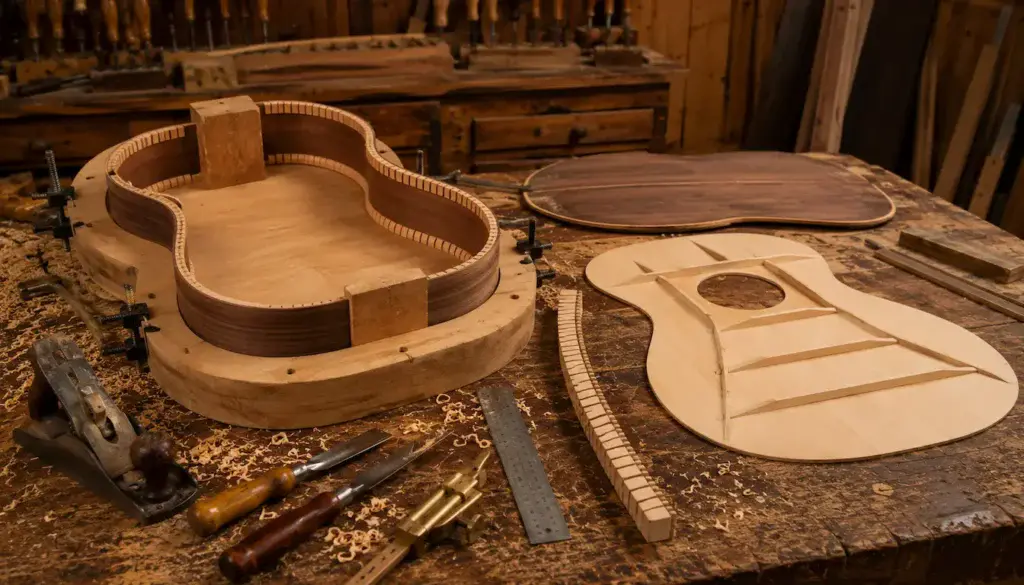
With the sides held securely in the mold, kerfing is added along the inside edges to create a larger gluing surface for the top and back.
The body structure is carefully leveled and prepared so every part fits together cleanly.
The braced soundboard and back are then glued to the rim assembly, closing the body and creating the guitar’s soundbox.
Once the glue has cured, the excess wood is trimmed away and the edges are cleaned up.
This is a major turning point in the build.
For the first time, you are no longer looking at separate parts — you are holding the body of an acoustic guitar.
👉 Wondering what you’ll need to handle all these steps?
See What Tools Do You Need to Build an Acoustic Guitar? and start putting together the tools that will follow you through the build.
 Building the Acoustic Guitar Body
🎀 Step 5: Add the Binding and Decorative Details
Binding protects the edges of the guitar body while also giving the instrument a clean, finished appearance.
Narrow channels are carefully routed around the top and back before the binding strips are bent, fitted, and glued into place.
This is also where decorative details such as purfling can be added.
The work is precise, and small gaps or uneven joints can be difficult to hide later.
The guitar may still be unfinished, but its personality is beginning to appear.
These small details are where craftsmanship starts becoming character.
🪵 Step 6: Build and Shape the Neck
The neck begins as a solid piece of wood that must be shaped into one of the most important parts of the guitar.
The headstock is formed, the truss rod is installed, and the heel is carefully shaped to fit the body.
The fingerboard is prepared separately before being attached to the neck.
Once everything is joined, the back of the neck is carved and refined until it feels comfortable in the hand.
This stage requires patience because the neck affects both how the guitar plays and how it feels.
A beautiful guitar may catch your eye — but the neck is where your hands decide whether they love it.
📏 Step 7: Fit the Neck to the Body
The neck must meet the guitar body at exactly the right angle.
Even a small error here can create problems with string height, bridge placement, and the final setup.
The neck joint is carefully fitted and adjusted until the centerline, alignment, and angle are correct.
This may take several rounds of fitting, checking, and removing tiny amounts of wood.
This is not a stage to rush.
A perfectly finished guitar will never play its best if the neck geometry is wrong.