
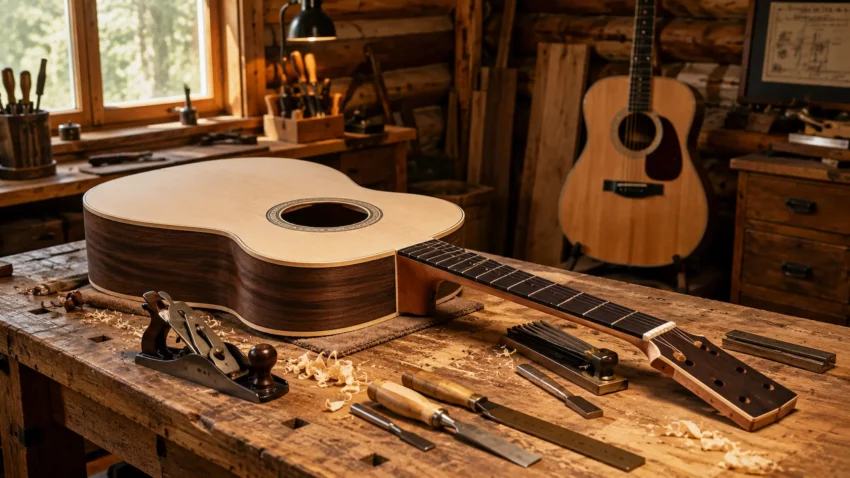
Building an acoustic guitar can seem like the kind of project reserved for master luthiers with decades of experience.
Bent sides, delicate bracing, precise neck angles, and a body that somehow has to sound as beautiful as it looks — it’s easy to wonder whether a first-time builder has any business trying.
But here’s the truth:
you don’t have to be a master luthier to build your first acoustic guitar.
You need patience, a willingness to learn, and the courage to take the project one careful step at a time.
Will it challenge you?
Absolutely.
Will you make mistakes?
Probably so.
But if you’ve ever looked at an acoustic guitar and thought, I wonder if I could actually build one of those…
The answer is yes, you can! 🎸
🎸 Yes, You Really Can Build an Acoustic Guitar
An acoustic guitar may look impossibly complicated, but every one of them is built one step at a time.
- The sides are bent.
- The braces are shaped.
- The body is closed.
- The neck is fitted.
Each individual job can be learned.
The real challenge isn’t knowing how to do everything before you begin.
It’s having the patience to learn each step as you reach it.
Your first acoustic guitar probably won’t be perfect — and it doesn’t need to be.
The goal is to build something real, learn how the instrument works from the inside out, and eventually string up a guitar that didn’t exist until you built it.
That alone makes the journey worth taking.

🪵 An Acoustic Guitar Is a Different Kind of Build
If you’ve built an electric guitar kit before, some of this will feel familiar.
You’ll still work with wood, shape parts, fit a neck, install frets, apply a finish, and bring the instrument to life with a final setup.
But an acoustic guitar asks more of the builder.
There’s no solid body to hide behind.
The thin wooden top, the internal bracing, the shape of the body, and the way everything fits together all affect how the finished guitar sounds.
That doesn’t mean you need to become a master luthier before you begin.
It simply means an acoustic guitar rewards patience, careful work, and a willingness to understand why each step matters.
You’re not just assembling a guitar.
You’re building something that actually creates the sound.
🎸 Shaping the Sound From the Inside Out

🧰 What Skills Do You Actually Need?
You don’t need years of woodworking experience to build your first acoustic guitar.
You don’t need a shop full of expensive tools, either.
What you do need is the ability to slow down and work carefully.
- You’ll measure.
- You’ll sand.
- You’ll shape wood.
- You’ll fit pieces together, take them apart, make small adjustments, and try again.
Some steps will feel familiar right away.
Others may take a few tries before they finally make sense.
The most important skill isn’t knowing how to build an acoustic guitar before you start.
It’s being willing to learn how to build one along the way.
👉 Wondering what you’ll need at the workbench?
See What Tools Do You Need to Build an Acoustic Guitar? and start with the tools that matter most.
🪚 What Will Be the Hardest Part?
There probably won’t be one single step that makes or breaks the entire build.
The real challenge will be doing a lot of small things carefully enough that they all work together.
Bending the sides may test your patience.
Shaping the braces will take a careful hand.
Fitting the neck and getting the geometry right will demand your full attention.
And there will probably be moments when something doesn’t fit the way you expected.
- That’s part of building a guitar.
- You stop.
- You figure out what happened.
- You make an adjustment.
Then you keep going.
The hardest part may simply be trusting yourself enough to start.
🧩 Kit or Scratch Build?
There’s more than one way to build your first acoustic guitar.
A kit gives you a head start.
Many of the difficult parts are already prepared, and you can focus on learning how the guitar goes together without making every single piece from raw lumber.
A scratch build takes you deeper.
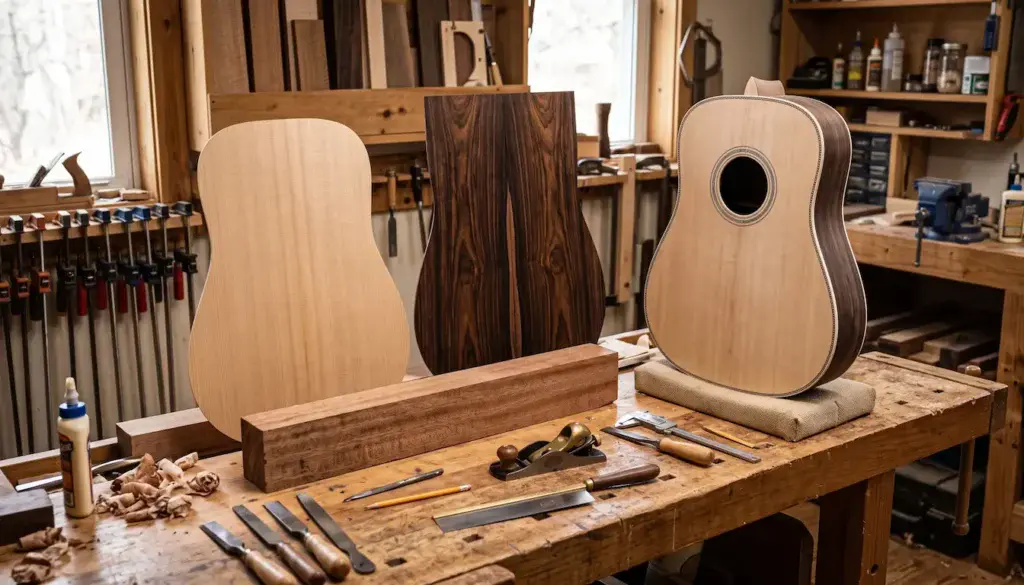
You choose the wood, shape the parts, bend the sides, carve the braces, and make decisions that can change the way the finished guitar looks, feels, and sounds.
Neither one is cheating.
A kit can teach you how an acoustic guitar is built.
A scratch build can teach you why it’s built that way.
The right place to start depends on how deep you want to go.
And there’s nothing wrong with starting with a kit and working your way toward building one from scratch.
🎸 Two Ways to Start the Journey
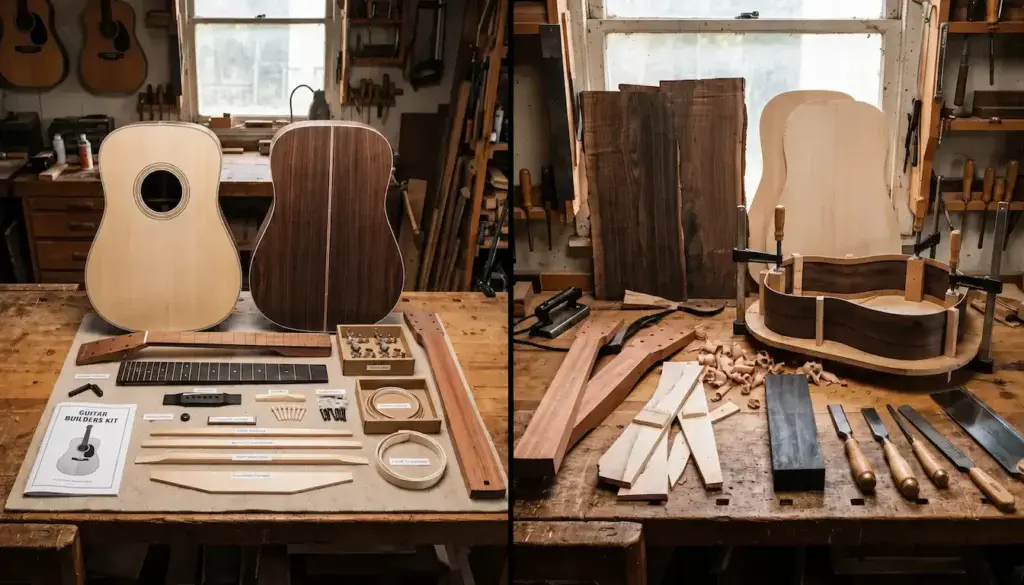
Solo APK-10 DIY Dreadnought Acoustic Guitar Kit
This Solo Kit gives first-time builders a practical way to experience the acoustic guitar-building process without starting completely from scratch.
The major components are already prepared, allowing you to focus on assembly, fitting, finishing, and setup.
 Solo Guitars Product: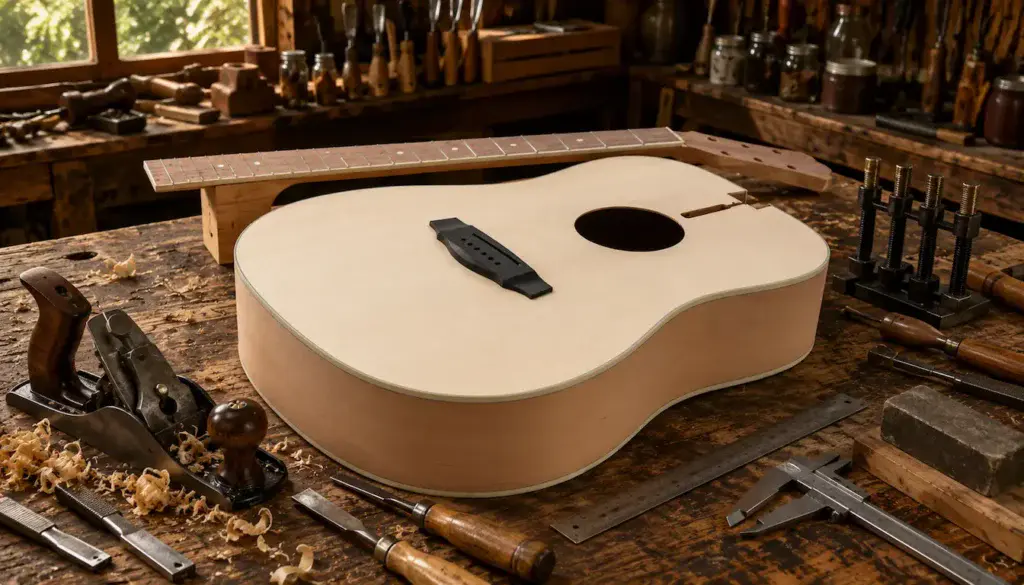
 Your Guitar, Your Build, Your Sound