
Choosing the right bracing method is one of the biggest decisions in acoustic guitar design.
Every bracing pattern influences the instrument’s strength, responsiveness, projection, and tonal character, making it an important consideration for both builders and players.
In this guide, we’ll compare the most common acoustic guitar bracing methods, explain where each one is used, and explore how different designs affect the way an acoustic guitar sounds and performs.
👉 New to guitar bracing?
Before comparing different designs, read What Is Acoustic Guitar Bracing?
to understand the purpose of internal bracing and why it’s essential to every acoustic guitar.

🎯 Why Bracing Methods Matter
No single bracing method is perfect for every guitar.
A bracing pattern must balance several competing goals:
- Structural strength
- Weight
- Flexibility
- Volume
- Sustain
- Tonal balance
Different builders prioritize these qualities differently, which is why you’ll find a variety of bracing systems across steel-string and classical guitars.
The best method depends on the instrument being built and the sound the builder hopes to achieve.
❌ There Is No “Best” Bracing Method
Despite the title of this article, there isn’t one bracing pattern that’s objectively better than all the others.
Instead, each design excels in different situations.
For example:
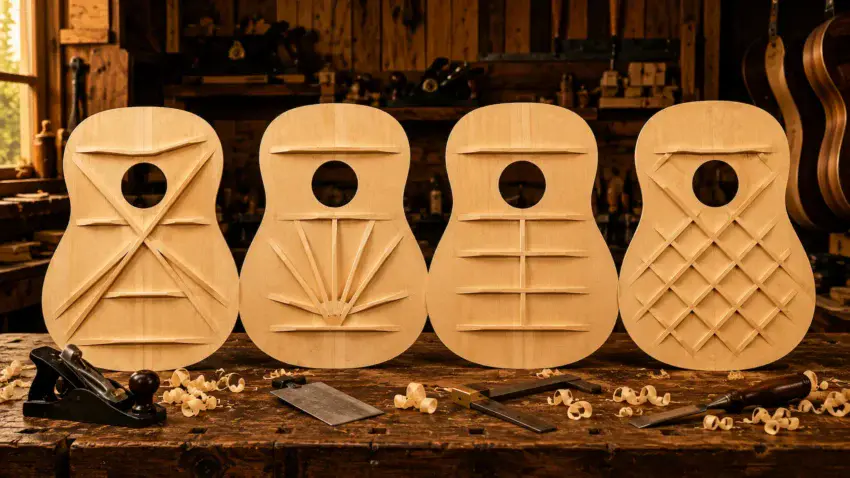
- X-bracing dominates modern steel-string guitars.
- Fan bracing remains the standard for classical guitars.
- Ladder bracing is loved for its vintage character.
- Lattice bracing pushes the limits of modern guitar design.
The “best” bracing method is simply the one that matches the guitar’s intended purpose.
⭐ X-Bracing
Invented in the 1800s and made famous by C. F. Martin & Co., X-bracing is by far the most common bracing pattern found in modern steel-string acoustic guitars.
Two large braces cross beneath the bridge to form an “X,” while several smaller braces support the lower bout and stabilize the soundboard.
Advantages
✔️ Outstanding structural strength
✔️ Balanced tone
✔️ Excellent bass response
✔️ Versatile for many playing styles
Best For
- Dreadnoughts
- OMs
- Grand Auditoriums
- Fingerstyle
- Flatpicking
- General-purpose acoustic guitars
🌿 Fan Bracing
Fan bracing uses several braces that spread outward from the bridge like the ribs of a handheld fan.
Because nylon strings create much less tension than steel strings, this lighter design allows the soundboard to vibrate more freely.
Advantages
✔️ Warm, expressive tone
✔️ Fast response
✔️ Excellent note separation
✔️ Lightweight construction
Best For
- Classical guitars
- Flamenco guitars
- Nylon-string instruments
🪵 Ladder Bracing
Ladder bracing consists of several straight braces running horizontally across the soundboard.
Although it’s one of the oldest bracing systems, it remains popular among builders recreating vintage instruments.
Advantages
✔️ Simple construction
✔️ Dry vintage tone
✔️ Strong midrange
✔️ Authentic historic sound
Best For
- Vintage recreations
- Blues guitars
- Early acoustic designs
🕸️ Lattice Bracing
Lattice bracing is a modern design that uses a lightweight crisscross pattern instead of a few large braces.
The goal is to create an incredibly stiff yet lightweight soundboard that produces exceptional volume and responsiveness.
While less common than X-bracing or fan bracing, lattice bracing has become popular among innovative luthiers looking to maximize performance.
Advantages
✔️ Extremely lightweight
✔️ Excellent projection
✔️ Fast response
✔️ Modern high-performance design
Best For
- Concert guitars
- Contemporary classical guitars
- Custom-built instruments
⚖️ Comparing the Most Popular Bracing Methods
Each bracing method has its own strengths, making it suitable for different styles of music and guitar construction.
| Bracing Method | Strength | Tone | Common Use |
|---|---|---|---|
| X-Bracing | Excellent | Balanced with strong bass | Steel-string acoustic guitars |
| Fan Bracing | Moderate | Warm and articulate | Classical guitars |
| Ladder Bracing | Good | Dry, woody, vintage | Historic and blues guitars |
| Lattice Bracing | Excellent | Loud and highly responsive | Modern custom instruments |
Rather than searching for the “best” design, experienced builders choose the pattern that best complements the guitar they’re creating.
🎵 How Bracing Methods Affect Tone
The bracing pattern beneath the soundboard influences nearly every aspect of an acoustic guitar’s voice.
Different designs can change:
- Volume
- Sustain
- Bass response
- Treble clarity
- Projection
- Dynamic range
- Responsiveness
Even subtle differences in brace height, width, tapering, and scalloping can dramatically change how the soundboard vibrates.
That’s why two guitars built from the same woods can still sound completely different.
Wayne’s Workshop Tip
Many beginning builders focus on expensive tonewoods, but experienced luthiers know that excellent brace shaping often has just as much influence on the finished sound.
🪚 Modern Variations of X-Bracing
Although traditional X-bracing remains the industry standard, many builders customize the design to achieve different tonal characteristics.
Common variations include:
Forward-Shifted X-Bracing
Moves the X slightly closer to the soundhole, often producing:
- Stronger bass
- Greater responsiveness
- More open sound
Rear-Shifted X-Bracing
Moves the X farther from the soundhole to increase structural stability and create a tighter, more controlled voice.
Scalloped Bracing
Removes carefully shaped portions of the braces to reduce weight while allowing the soundboard to vibrate more freely.
Non-Scalloped Bracing
Leaves the braces at their full height, producing a stronger, more focused sound with additional structural rigidity.
These small variations demonstrate that even within a single bracing method, builders have tremendous freedom to fine-tune an instrument’s personality.
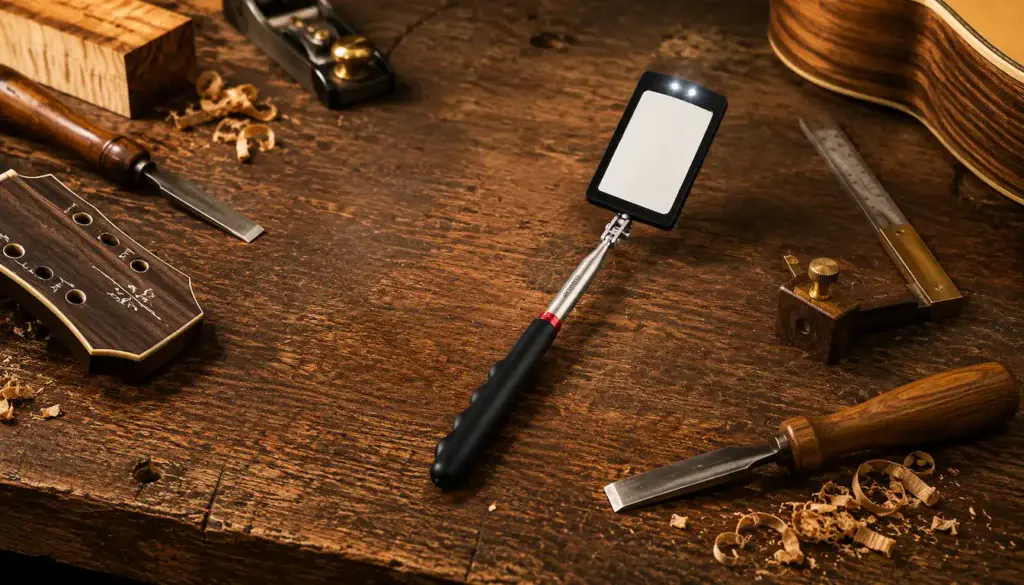
Telescoping LED Lighted Flexible Inspection Mirror
An inspection mirror is one of the simplest and most affordable tools for exploring the hidden interior of an acoustic guitar.
With its telescoping handle, built-in LED lights, and 360° swivel head, you can easily inspect braces, glue joints, bridge plates, and other hard-to-reach areas.
 Amazon Product Suggestion:
 Telescoping LED Lighted Flexible Inspection Mirror
🔬 How Builders Choose the Right Bracing Method
Experienced luthiers don’t simply choose the strongest bracing pattern — they choose the one that best matches the guitar’s intended purpose.
Several factors influence that decision, including:
- The type of strings being used
- Body size and shape
- Top wood species
- Playing style
- Desired tonal character
- Overall weight of the instrument
A lightly built fingerstyle guitar may benefit from a more responsive bracing design, while a bluegrass dreadnought often requires stronger bracing to handle aggressive playing and produce powerful projection.
Choosing the right bracing method is always a balance between structural stability and musical performance.
👉 The same bracing pattern can sound completely different depending on the wood you choose.
Learn how spruce, cedar, mahogany, and rosewood influence your guitar’s voice in What Wood Do You Need to Build an Acoustic Guitar?
⚠️ Common Misconceptions About Bracing Methods
There are plenty of myths surrounding acoustic guitar bracing.
Here are a few of the most common:
Myth: One bracing pattern is better than all the others.
Every bracing method has strengths and weaknesses.
The best choice depends on the type of guitar being built and the sound the builder wants to achieve.
Myth: All X-braced guitars sound the same.
Even two guitars using traditional X-bracing can sound completely different because of brace shaping, scalloping, wood selection, and overall construction.
Myth: More braces always produce a stronger guitar.
Adding unnecessary braces often makes the soundboard too stiff, reducing resonance and volume.
Myth: Bracing only supports the soundboard.
Bracing provides structural strength, but it also controls how the soundboard vibrates, making it one of the biggest contributors to an acoustic guitar’s voice.
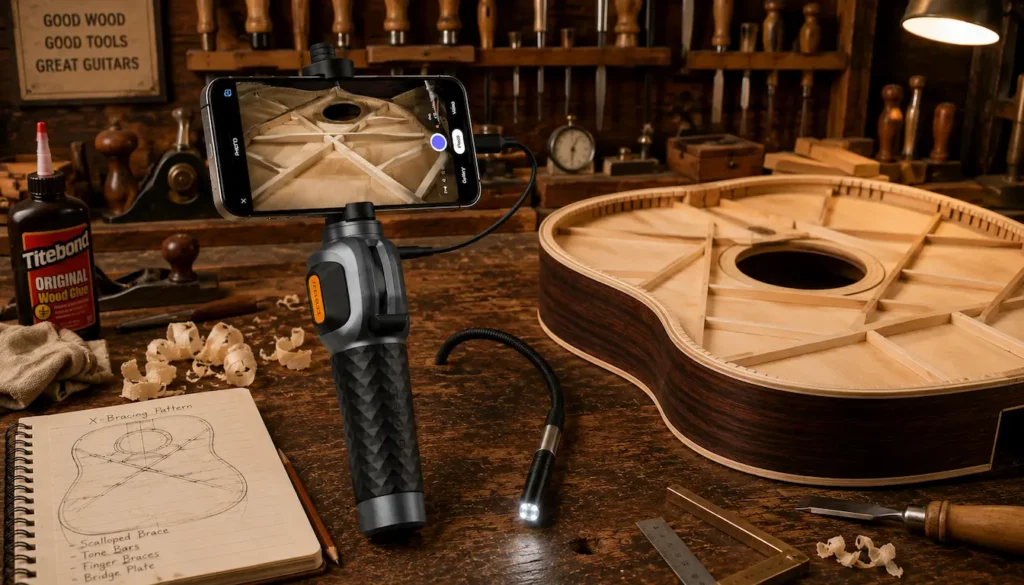
Teslong Articulating Borescope
A quality borescope lets you explore the hidden interior of an acoustic guitar with remarkable clarity.
Its articulating camera and bright LED lighting make it easy to inspect braces, glue joints, bridge plates, and other hard-to-reach areas without taking the instrument apart.
Amazon Product Suggestion:
Teslong Articulating Borescope
A quality borescope gives you an up-close view of the
hidden craftsmanship inside an acoustic guitar without disassembly.
The Teslong USB-C Two-Way Articulating Borescope features a
flexible articulating camera and bright LED lighting,
making it easy to inspect braces, glue joints, bridge plates,
and other hard-to-reach areas.
Why It’s Great
✔️ Two-way articulating camera reaches difficult angles
✔️ Bright adjustable LED lighting for clear inspections
✔️ Connects directly to compatible USB-C smartphones
✔️ Ideal for inspecting braces, glue joints, and repairs
👉 Ready to see the most popular design in action?
Continue with How to Brace an Acoustic Guitar to learn how traditional X-bracing is laid out, shaped, glued, and fine-tuned for strength and exceptional tone.
 Different Designs, Different Voices

🏁 Final Thoughts…
No single acoustic guitar bracing method is perfect for every instrument.
Each design represents a different philosophy of:
- balancing strength,
- flexibility,
- and tone,
… allowing builders to create guitars with distinct personalities and musical voices.
Understanding these different bracing methods gives you a deeper appreciation for the craftsmanship hidden beneath the soundboard.
Whether you’re building your first acoustic guitar or simply learning more about how these instruments work, recognizing the strengths of each design will help you better understand why great guitars sound the way they do.
Your Guitar, Your Build, Your Sound
You don’t need a custom shop or a tech on speed dial.
All you need is a little guidance, some patience, and a place to go that shows you what to do next.
Come on man… You got this.