
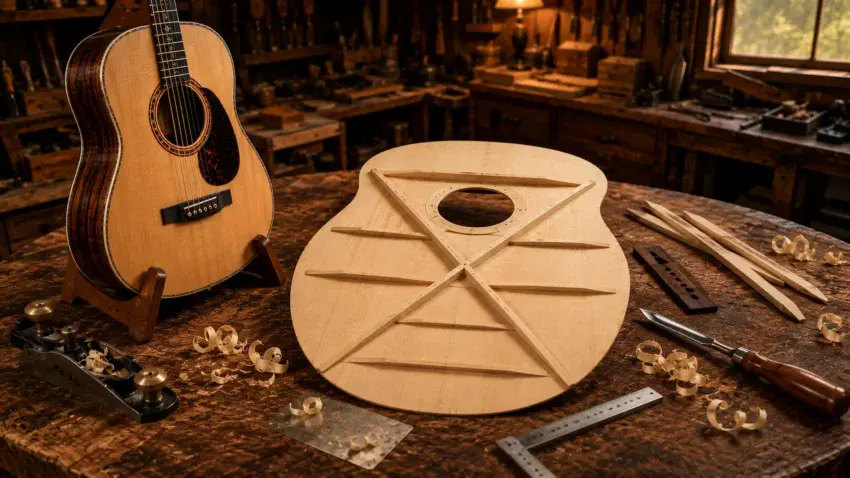
If you’ve ever looked inside an acoustic guitar and noticed a network of wooden strips glued beneath the soundboard, you’ve seen one of the most important parts of the instrument.
Known as acoustic guitar bracing, this hidden framework strengthens the guitar while shaping the tone, volume, sustain, and overall character of every note it produces.
In this guide, you’ll learn what acoustic guitar bracing is, why it’s essential, how it affects sound quality, and why luthiers spend countless hours carefully designing and shaping these hidden components.
👉 Want to learn the complete building process?
After understanding what bracing is and why it matters, continue with How to Brace an Acoustic Guitar for a complete step-by-step guide to laying out, carving, gluing, and shaping acoustic guitar braces.

🎯 Why Acoustic Guitar Bracing Matters
Without internal bracing, an acoustic guitar simply wouldn’t survive.
A typical set of steel strings places well over 150 pounds of tension on the soundboard.
Since the top is usually only a few millimeters thick, it needs carefully designed structural support to prevent warping, cracking, or collapsing over time.
But strength is only part of the story.
Bracing also determines how the soundboard vibrates, making it one of the biggest factors influencing an acoustic guitar’s voice.
Proper bracing helps:
- Support the soundboard under heavy string tension
- Improve resonance and sustain
- Distribute vibration across the top
- Increase structural stability
- Shape the guitar’s tonal character
Great acoustic guitars are designed from the inside out.
🪵 What Is Acoustic Guitar Bracing?
Acoustic guitar bracing refers to the system of wooden braces glued to the underside of the soundboard — and, to a lesser extent, the back of the guitar.
These braces are usually made from lightweight, quartersawn spruce because it offers an outstanding combination of stiffness and low weight.
Rather than simply reinforcing the instrument, each brace is carefully positioned to guide the way the soundboard flexes as the strings vibrate.
Think of the braces as the guitar’s internal skeleton.
Just as a skeleton provides strength while allowing movement, acoustic guitar braces support the soundboard while allowing it to vibrate freely enough to create beautiful music.
🔊 How Bracing Affects Sound
Every vibration produced by your strings eventually reaches the soundboard through the bridge.
From there, the braces control how that energy spreads across the guitar top.
Small differences in brace size, shape, and placement can influence:
- Volume
- Sustain
- Bass response
- Treble clarity
- Projection
- Dynamic range
This is why experienced luthiers often spend hours carefully carving and fine-tuning braces.
Even removing a small amount of wood can noticeably change how an instrument responds.
Well-designed bracing allows the soundboard to remain both strong and lively.
🧩 Common Acoustic Guitar Bracing Patterns
Over the years, builders have developed several different bracing designs, each with its own tonal personality.
X-Bracing
The most common design used on modern steel-string acoustic guitars.
Advantages include:
- Excellent strength
- Balanced tone
- Rich bass response
- Outstanding versatility
Fan Bracing
Traditionally found on classical guitars.
It offers:
- Warm tone
- Excellent note separation
- Fast response
- Lightweight construction
Ladder Bracing
An older design commonly seen on vintage instruments.
Known for:
- Woody character
- Strong midrange
- Vintage tonal personality
Lattice Bracing
A more modern approach designed to maximize stiffness while reducing weight.
Typically used by advanced custom builders seeking maximum efficiency from the soundboard.
Telescoping LED Lighted Flexible Inspection Mirror
An inspection mirror is one of the easiest ways to explore the hidden craftsmanship inside an acoustic guitar.
Whether you’re building, repairing, or simply satisfying your curiosity, it lets you clearly examine braces, glue joints, and other internal components that are normally out of sight.
 Amazon Product Suggestion:
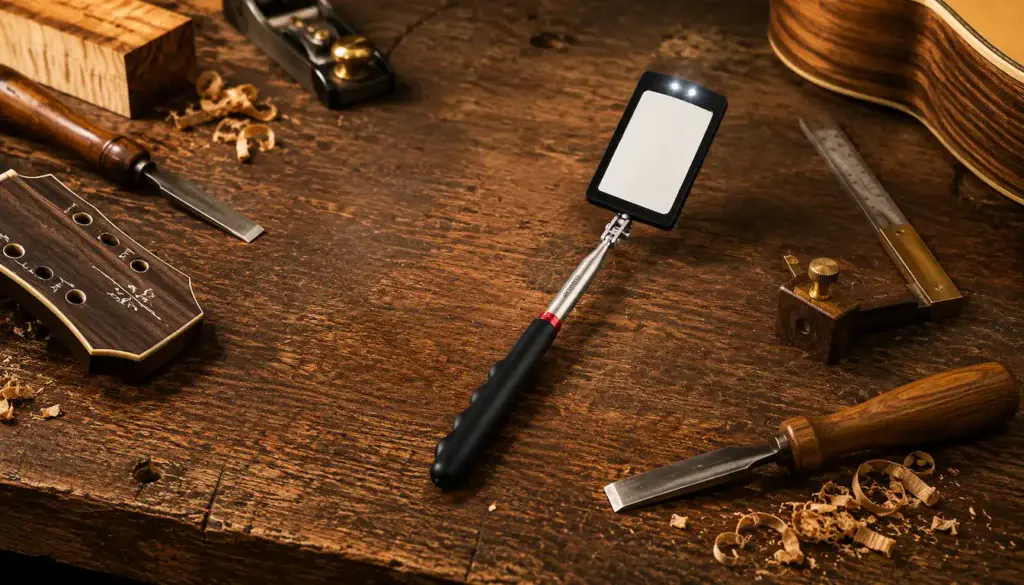
✔️ Telescoping LED Lighted Flexible Inspection Mirror
🪚 What Are Acoustic Guitar Braces Made Of?
Although several woods have been used throughout history, quartersawn spruce remains the gold standard for acoustic guitar braces.
Spruce offers an exceptional strength-to-weight ratio, allowing builders to create braces that are incredibly stiff without adding unnecessary mass to the soundboard.
Popular choices include:
- Sitka Spruce
- Adirondack (Red) Spruce
- European Spruce
- Engelmann Spruce
Each species has slightly different characteristics, but all provide the stiffness needed to support the soundboard while allowing it to vibrate efficiently.
The straighter and more consistent the grain, the better the brace stock will perform.
⚖️ Strength vs. Flexibility
One of the biggest challenges in acoustic guitar design is finding the perfect balance between structural strength and tonal responsiveness.
Braces that are too large or too heavy may produce an instrument that lasts forever — but sounds stiff and lifeless.
On the other hand, braces that are carved too aggressively may produce wonderful tone initially but risk distortion or failure years later.
Experienced luthiers carefully remove small amounts of material until the braces provide just enough strength while allowing the soundboard to move as freely as possible.
It’s a balancing act that combines woodworking, engineering, and artistry.
✂️ Why Luthiers Shape Their Braces
If you examine an unfinished acoustic guitar, you’ll notice the braces aren’t left as simple square blocks of wood.
Instead, they’re carefully carved into smooth, tapered profiles.
This process serves several important purposes:
- Removes unnecessary weight
- Improves vibration
- Increases responsiveness
- Fine-tunes tonal balance
Many builders compare brace carving to tuning an instrument before it’s ever played.
Every shaving removed changes the way the soundboard reacts.
Wayne’s Workshop Tip
Always remove small amounts of wood during brace shaping.
It’s easy to make another pass with a finger plane or cabinet scraper, but once wood is gone, there’s no putting it back.
🏗️ How Bracing Has Evolved
Acoustic guitar bracing has changed dramatically over the last two centuries.
Early guitars often used simple ladder bracing because it was easy to build and provided adequate support for lower string tension.
As steel strings became more common, builders needed stronger designs that could withstand significantly greater forces.
This led to the widespread adoption of X-bracing, which remains the standard for most modern steel-string acoustic guitars.
Today’s custom luthiers continue experimenting with:
- Forward-shifted X-bracing
- Scalloped bracing
- Lattice bracing
- Hybrid brace designs
Each variation offers a different balance of strength, projection, sustain, and tonal color.
Teslong Articulating Borescope
Amazon Product Suggestion:
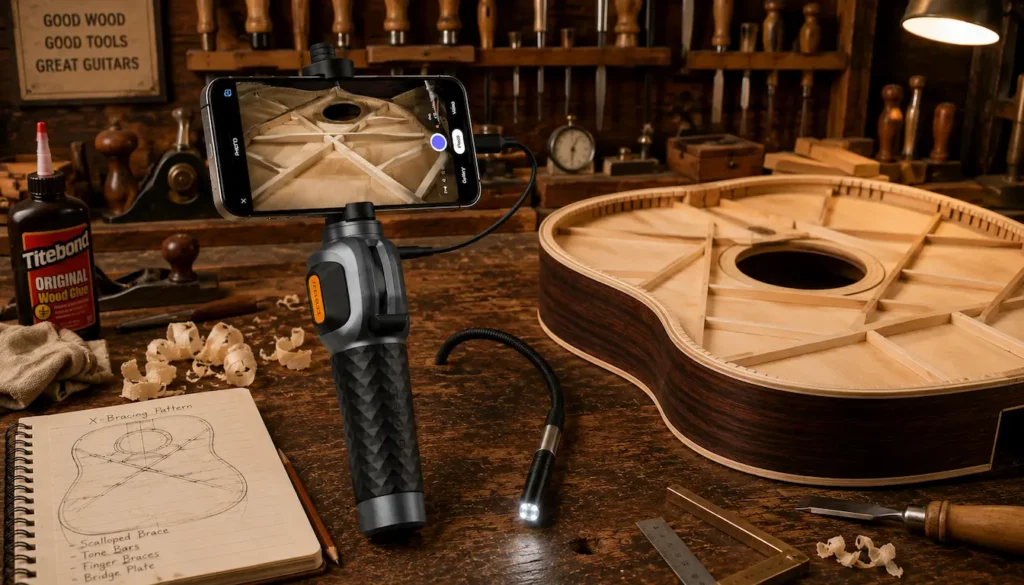
✔️ Teslong Articulating Borescope
If you’re serious about understanding acoustic guitar construction,
a quality borescope lets you inspect areas that would otherwise remain hidden.
It’s perfect for examining bracing, bridge plates, glue joints, and repairs
without removing the back of the guitar.
Why It’s Great
✔️ Crystal-clear view inside the guitar
✔️ Articulating camera reaches difficult angles
✔️ Excellent for inspections and repairs
✔️ Works with phones for live viewing and photos
❤️ Why Hidden Craftsmanship Matters
One of the beautiful things about acoustic guitar building is that some of the finest craftsmanship is never seen.
Once the back is glued onto the body, the braces disappear forever.
Yet every note the guitar produces will be influenced by the countless hours spent selecting wood, shaping braces, and carefully tuning the soundboard.
It’s a reminder that true craftsmanship isn’t always visible — but it’s always heard.
👉 Now that you understand the hidden structure of the soundboard, continue with How to Build an Acoustic Guitar Body to see how all of the major components come together into a complete guitar.
🔍 How to See Acoustic Guitar Bracing Without Taking the Guitar Apart
One of the easiest ways to understand acoustic guitar bracing is to look inside a finished instrument.
Using a small inspection mirror or articulating borescope, you can clearly see:
- X-brace,
- tone bars,
- bridge plate,
- finger braces,
- and many of the glue joints that hold everything together.
Take your time exploring the inside of the guitar.
You’ll quickly gain a new appreciation for the precision and craftsmanship hidden beneath the soundboard.
Even factory-built guitars reveal just how important bracing is to the instrument’s overall strength and tone.
⚠️ Common Misconceptions About Guitar Bracing
There’s a lot of misinformation surrounding acoustic guitar bracing.
Here are a few of the most common myths.
Myth: More bracing always makes a stronger guitar.
Not necessarily.
Excessive bracing can make the soundboard too stiff, reducing volume, resonance, and responsiveness.
Myth: Thinner braces always produce better tone.
Removing too much material may improve responsiveness at first, but it can also weaken the guitar and shorten its lifespan.
Myth: Every acoustic guitar uses the same bracing pattern.
Different builders use different layouts, brace heights, scalloping techniques, and wood species to achieve their desired sound.
Myth: Bracing only supports the guitar.
Bracing provides structural support, but it also plays one of the biggest roles in shaping the instrument’s voice.
👉 Great bracing starts with the right tools. If you’re building your first acoustic guitar,
check out What Tools Do You Need to Build an Acoustic Guitar?
to see the essential tools that make layout, carving, and glue-up easier and more accurate.
 Hidden Craftsmanship

🏁 Final Thoughts…
Acoustic guitar bracing is one of the most important — and least visible — parts of the entire instrument.
While most players admire the:
- beautiful woods,
- glossy finish,
- and elegant curves,
… it’s the carefully engineered framework beneath the soundboard that allows the guitar to withstand years of string tension while producing rich, expressive tone.
Whether you’re planning to build your first acoustic guitar or simply want to better understand the instrument you already own, learning about bracing gives you a deeper appreciation for the craftsmanship hidden inside every great guitar.
Once you understand what the braces do, you’ll never look at an acoustic guitar the same way again.
Your Guitar, Your Build, Your Sound
You don’t need a custom shop or a tech on speed dial.
All you need is a little guidance, some patience, and a place to go that shows you what to do next.
Come on man… You got this.