Skip to content
Electric Guitar Kits Logo
Menu
  • Home
  • Start Here
    • Build Your First Guitar Kit
    • Essential Tools Every Electric Guitar Kit Builder Should Have
    • Setting Up The Bridge And Neck On Your Electric Guitar Kit
    • Are DIY Guitar Kits Good For Beginners?
    • Mastering Tone Controls on Your Electric Guitar Kit (Beginner-Friendly Guide)
  • Fix & Setup
    • How To Adjust Truss Rod For Neck Relief In Guitar Kits
    • Adjusting Action On An Electric Guitar
    • How To Properly Set Up Your Electric Guitar Kit For Intonation
    • Fix Buzzing Frets & Dead Notes
    • Setting Up The Bridge And Neck On Your Electric Guitar Kit
  • Pickups & Wiring
    • Understanding Humbucker Vs Single Coil Pickups In Kits
    • How Pickup Height Affects Electric Guitar Tone
    • How To Adjust Pickup Height On Electric Guitar
    • Guide To Wiring Your Electric Guitar Kit For Optimal Performance
    • How To Shield Your Guitar’s Electronics For Noise Reduction
  • Tone & Upgrades
    • How Tone Pots Shape Feel and Control on Your Guitar
    • How Guitar Electronics Shape Tone Beyond Pickups
    • Does Guitar Wood REALLY Affect Tone? (What Builders Notice First)
    • Best Pickups for Guitar Kits (Budget to Pro Tone Upgrades)
    • How To Choose The Perfect Nut Material For Your Electric Guitar
  • Mods & Custom Builds
    • D.I.Y. Fretboard Inlays For Guitar Kits (Creative Upgrade Guide)
    • D.I.Y. Custom Guitar Inlays (Step-By-Step Guide)
    • How To Choose Between Neck-Through And Bolt-On Necks In Kits
    • String Changing Techniques To Protect Your Guitar
    • Electric Guitar Customization & Mods Guide
Menu
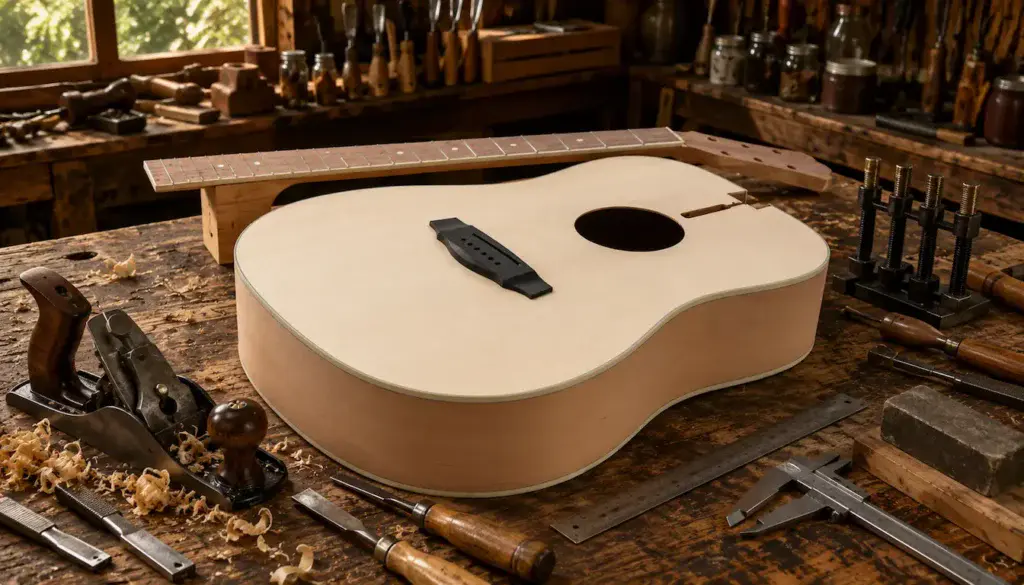
Acoustic guitar under construction surrounded by tonewood, hardware, finishing supplies, and guitar-building tools on a warm luthier’s workbench.

How Much Does It Cost to Build an Acoustic Guitar?

Posted on July 6, 2026 by Wayne

Building an acoustic guitar can save you money.

Or it can cost more than buying a perfectly good guitar off the wall.

The difference usually comes down to:

  • how you build
  • what you already own
  • how quickly you start adding tools
  • better wood
  • upgraded hardware
  • and all the little supplies you didn’t think about when you started

A kit may give you a clearer idea of the cost upfront.
A scratch build can start with raw wood and grow from there.
And your first guitar may cost more than the next one because you’re not just building an instrument.

You’re building the workshop too.

So, how much does it really cost to build an acoustic guitar?

Let’s break down where the money actually goes.


👉 Wondering how much of that cost depends on the way you build?
Compare an Acoustic Guitar Kit or Scratch Build and see how your choice can change what you spend before the first string ever goes on.


💵 The Guitar Is Only Part of the Cost

When you first think about the price of building an acoustic guitar,
it’s easy to focus on the guitar itself.

  • The wood.
  • The neck.
  • The hardware.
  • The strings.

But your first build may also need:

  • clamps
  • measuring tools
  • shaping tools
  • glue, sandpaper
  • finishing supplies

and a few things you won’t realize you need until the build is already underway.

Some of those costs belong to the guitar.

Others belong to the workshop.

That difference matters.

The tuners stay with the guitar.
The chisel stays with your shop.
The wood becomes part of the instrument.
The clamps will help you build the next five acoustic guitars.

That’s right…
You may not stop at just one!

Your first guitar may be paying for more than one build.


🧩 A Kit Gives You a Clearer Starting Price

One of the biggest advantages of an acoustic guitar kit is that you can see much of the cost before you begin.

The major pieces are usually included:

  • the body parts
  • the neck
  • the fingerboard
  • the bridge
  • and other major components

That makes it easier to answer the question:

How much is this guitar going to cost me?

But the price of the kit isn’t always the price of the finished guitar.

You may still need:

  • glue
  • sandpaper
  • finishing supplies
  • strings
  • a few tools you don’t already own

And it’s always worth checking exactly what comes in the box before you buy.

Still, a kit can remove a lot of the financial guesswork from a first build.

You know where you’re starting — even if you don’t know exactly where the spending will end.


🪵 Scratch Building Can Start Cheap — and Grow Fast

A scratch build can look less expensive at first.

Instead of buying a complete kit, you may start with:

  • a soundboard
  • back and side wood
  • a neck blank
  • fingerboard wood
  • bridge material
  • a few smaller pieces

But raw wood is only the beginning.

You may also need:

  • molds and templates
  • side-bending equipment
  • more clamps
  • specialized cutting and shaping tools
  • jigs you build yourself
  • extra materials for the mistakes you didn’t plan on making

If you already have a woodworking shop, some of those costs may barely affect you.

If you’re starting from an empty workbench, they can add up quickly.

The wood may be the cheapest part of learning how to build from scratch.


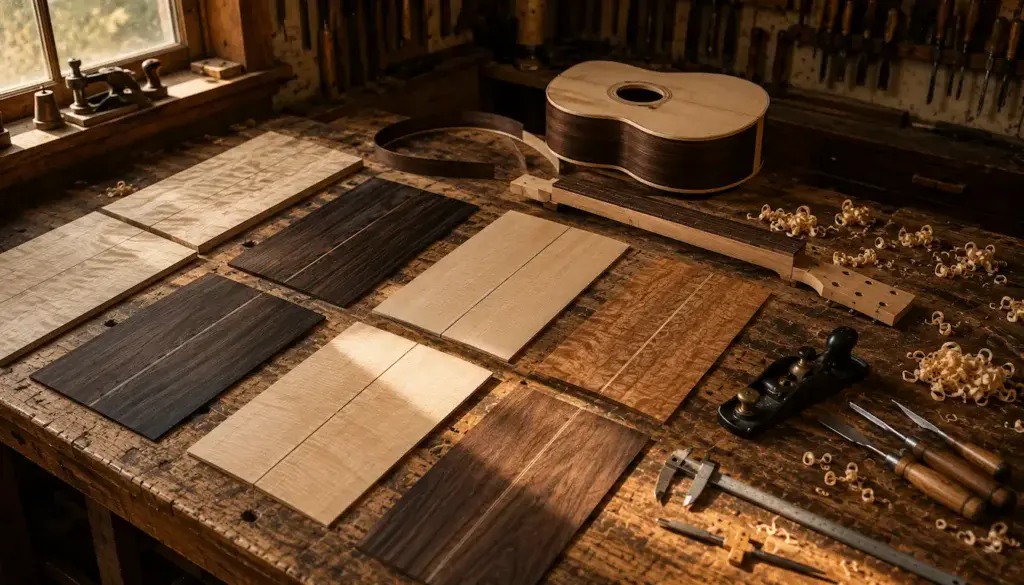
🎸 A Scratch Build Starts With More Than Wood
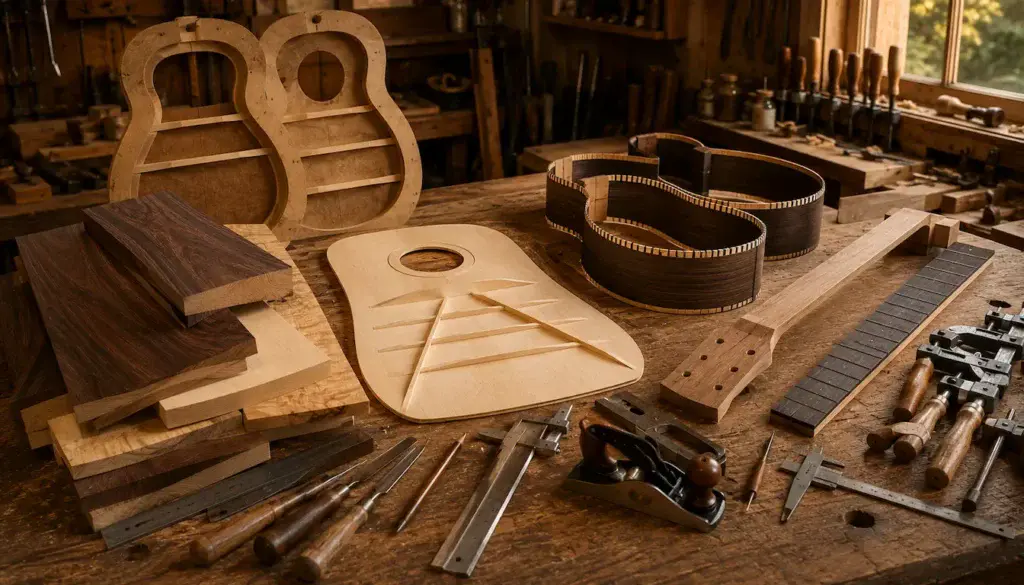

Raw acoustic guitar tonewood surrounded by molds, templates, clamps, and hand tools on a luthier’s workbench.
Raw materials may be only the beginning when you’re building an acoustic guitar from the ground up.

🛠️ Tools Can Be the Biggest Wild Card

Tools are where the cost of a first build can really start to move.

If you already have a woodworking shop, you may own many of the basics:

  • chisels
  • clamps
  • files
  • sanding blocks
  • measuring tools
  • a drill and other common power tools

But if you’re starting from scratch, even a simple tool list can add up.

And then come the specialty tools:

  • Fret tools.
  • Side-bending equipment.
  • Guitar molds.
  • Radius dishes.
  • Binding tools.
  • Jigs you didn’t know existed until you needed one.

The good news is that you don’t need everything at once.

Buy what you need for the job in front of you and let the workshop grow with the build.

The fastest way to make guitar building expensive is to buy every tool before you know why you need it.


👉 Not sure which tools belong on your first shopping list?
See What Tools Do You Need to Build an Acoustic Guitar? and start with the ones you’ll actually use.


🌲 Tonewood Can Be Affordable or Expensive

The wood you choose can change the cost of the build in a hurry.

A simple, good-quality tonewood set may be all you need for your first guitar.

Or you can start looking at:

  • highly figured wood
  • rare species
  • premium grading
  • perfectly matched sets
  • exotic back and side woods

And suddenly, the pile of wood on your bench is worth more than some finished guitars.

There’s nothing wrong with beautiful wood.

But expensive tonewood won’t fix poor joints, bad geometry, or rushed work.

For a first build, good, stable wood that you’re not afraid to cut may be the better investment.

The best tonewood isn’t always the one that costs the most.
It’s the one you’re ready to build with.


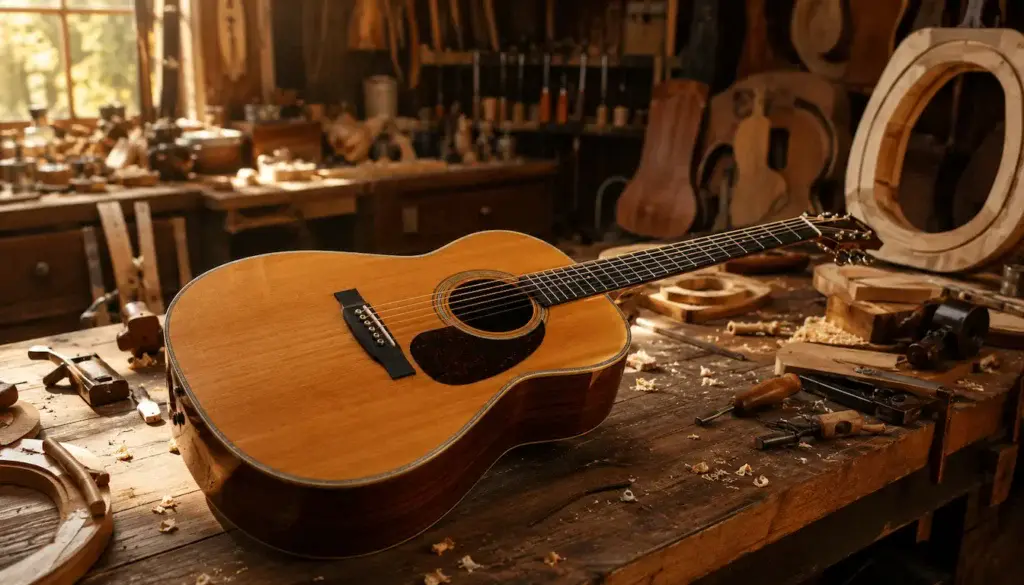
🎸 Tonewood Can Change the Budget Fast


Straight-grained and figured acoustic guitar tonewoods arranged beside a partially built guitar in a warm workshop.
Good guitar wood doesn’t have to be the rarest or most expensive set on the bench.

🔩 Hardware and Small Parts Add Up

Tuners, strings, a truss rod, fretwire, bridge pins, binding, purfling, and other small parts may not seem expensive by themselves.

But there are a lot of them.

And this is another place where it’s easy to start upgrading:

  • better tuners
  • premium bridge pins
  • decorative binding
  • custom inlays
  • higher-quality fretwire
  • upgraded hardware

A few extra dollars here and there can quietly turn into a much bigger number by the end of the build.

That doesn’t mean you should buy the cheapest parts you can find.

Spend money where quality matters.
Save it where a simple part will do the job just fine.

The little parts may be small, but the receipt they leave behind can get surprisingly big.


🎨 Finishing Supplies Have Their Own Price Tag

Once the woodworking is done, you still have to finish the guitar.

Depending on the finish you choose, you may need:

  • sealer
  • stain or dye
  • finish material
  • sandpaper and polishing supplies
  • clean cloths and applicators
  • safety equipment

Some finishing methods are simple and affordable.

Others can require more supplies, more equipment, and a lot more time.

And this is one part of the build where buying too much can be just as easy as buying too little.

You don’t need a professional spray booth to finish your first guitar.

But you do need a plan before you start buying supplies and opening cans.

The finish may be the last thing you put on the guitar, but it shouldn’t be the last cost you think about.


🧯 Mistakes Can Cost Money Too

Not every piece of wood will survive the build.

You may:

  • sand too far
  • cut something wrong
  • damage a piece during bending
  • ruin a finish and have to start over
  • buy the wrong part
  • discover that something simply doesn’t fit

That doesn’t mean the project is a failure.

It means you’re learning.

But it’s smart to leave a little room in the budget for the things that don’t go according to plan.

A replacement part or another piece of wood can be frustrating, but sometimes it’s just part of the cost of learning a new craft.

The goal isn’t to build without mistakes.
It’s to make sure one mistake doesn’t stop the build.


⏱️ Your Time Has Value Too

Most builders don’t count their own time when they talk about what a guitar cost to build.

And that’s fine.

You’re probably not paying yourself by the hour to work in your own shop.

But building an acoustic guitar takes time:

  • learning new skills
  • setting up tools and jigs
  • fitting parts
  • waiting for glue to dry
  • sanding
  • finishing
  • fixing mistakes

A kit may save time by doing some of the early work for you.
A scratch build asks you to take on more of the journey yourself.

You may never put a dollar amount on your time.

But it’s still part of what you’re investing in the build.

Money buys the materials.
Time turns them into a guitar.


👉 Wondering how much time you’re really signing up for?
See How Long Does It Take to Build an Acoustic Guitar? and find out where the hours actually go.

💡 Your First Guitar May Cost More Than Your Second

The first build is carrying more than its own weight.

You may be buying:

  • your first good set of chisels
  • your first collection of clamps
  • measuring tools
  • jigs and templates
  • finishing supplies
  • tools you’ll use for years

The second guitar won’t need all of that again.

  • The clamps are already hanging on the wall.
  • The chisels are already sharp.
  • The jigs are already built.

That’s why the cost of your first acoustic guitar can be misleading.

Part of that money isn’t really going into one guitar.

It’s buying your way into the next one and supplying your shop with some pretty cool tools!


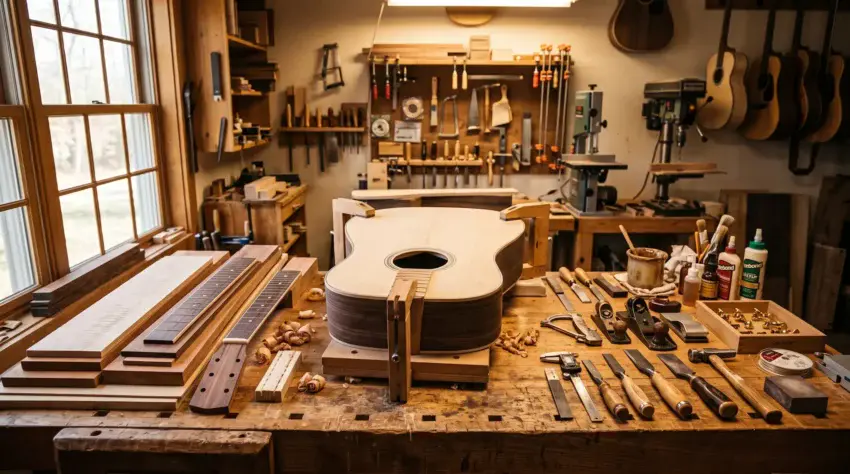
🎸 Your First Build Is Also Building the Workshop


Partially built acoustic guitar surrounded by a growing collection of luthier tools, jigs, and templates.
Many of the tools you buy for the first guitar will still be waiting when you start the second.

🎯 Set a Budget Before the Build Begins

You don’t need to know the exact cost of every piece before you start.

But it helps to decide what kind of build you can comfortably afford.

Think about:

  • the guitar itself
  • the tools you’ll need
  • finishing supplies
  • replacement parts and mistakes
  • a little room for the things you forgot

Then decide where you want to spend more.

Maybe the wood matters most to you.

Maybe you want better tuners.

Maybe you’d rather put the money into tools you’ll use on the next guitar.

A budget doesn’t have to take the fun out of the build.

It can keep one exciting project from turning into a pile of receipts you’re afraid to add up.

Know what you’re willing to spend before the guitar starts spending it for you.


⚖️ Is Building an Acoustic Guitar Cheaper Than Buying One?

Sometimes.

But saving money probably shouldn’t be the only reason you build.

A factory can buy materials in bulk, use specialized machinery, and build guitars far faster than you ever will at a home workbench.

So, if your only goal is to own a good acoustic guitar for the lowest possible price, buying one may make more sense.

But building gives you something the store can’t sell you.

  • You choose the wood.
  • You make the decisions.
  • You learn the craft.
  • You fix the mistakes.
  • You watch the instrument slowly come together under your own hands.

Every single detail on your guitar comes from YOUR decisions that you made along the way during the build process.

That’s PRICELESS!

And when you finally play it, you know exactly where it came from.

You may not build an acoustic guitar because it’s cheaper.

You build one because you want to build an acoustic guitar.


🎸 The Real Value Shows Up After the Build

When the guitar is finished, the money is spent.

But you still have:

  • the guitar you built
  • the tools you collected
  • the jigs and templates you made
  • the skills you learned
  • the mistakes you now know how to avoid
  • the confidence to build another one

That’s why it’s hard to judge the value of a guitar build by the final receipt alone.

Some of what you spent became an instrument.

Some of it became a workshop.

And some of it became knowledge you’ll carry into every guitar you build after this one.

The finished guitar may be what you can hold in your hands.

But that isn’t the only thing you built.


🧾 So, How Much Should You Expect to Spend?

There isn’t one number that works for every acoustic guitar build.

Your total cost depends on:

  • whether you start with a kit or build from scratch
  • what tools you already own
  • the wood you choose
  • the hardware and small parts you buy
  • how you finish the guitar
  • and how many unexpected expenses show up along the way

A simple first build can stay fairly modest.

A fully equipped workshop, premium tonewood, upgraded hardware, and specialty tools can push the cost much higher.

That’s why it helps to separate two questions:

How much will this guitar cost?

And:

How much will it cost me to start building guitars?

Those numbers may be very different.

The guitar has a price.
Becoming a builder is an investment.


🎸 The Receipt Doesn’t Tell the Whole Story


Completed handmade acoustic guitar surrounded by well-used tools and traces of the building process in a warm luthier’s workshop.
The finished guitar is only one of the things you carry away from your first build.

🏁 Final Thoughts…

So, how much does it cost to build an acoustic guitar?

The answer depends on what you already have, how you decide to build, and how far you want to take it.

A kit can give you a clearer starting price.

A scratch build can ask more from your workshop.

Better wood, upgraded hardware, specialty tools, finishing supplies, and a few mistakes along the way can all change the final number.

But the receipt doesn’t tell the whole story.

You’re also building:

  • a workshop
  • a collection of tools
  • new skills
  • better judgment
  • and the confidence to build the next guitar

Your first build may cost more than you expected.

It may even cost more than buying a finished guitar.

But when you finally pick it up and play it, you won’t be thinking about the receipts.

You’ll be listening to something that didn’t exist until you built it.


🎸 Your Guitar, Your Build, Your Sound

You don’t need a custom shop or a tech on speed dial.
All you need is a little guidance, some patience, and a place to go that shows you what to do next.

Come on man… You got this.

GuitarCrafts is here to help you along the way.


🎸Craft it. Play it. Own it! 🎸


Leave a Reply Cancel reply

Your email address will not be published. Required fields are marked *

  • Facebook
  • Pinterest
  • YouTube

© 2026 Guitar Crafts | Privacy Policy

© 2026 My Electric Guitar Kits Site | Powered by Superbs Personal Blog theme