
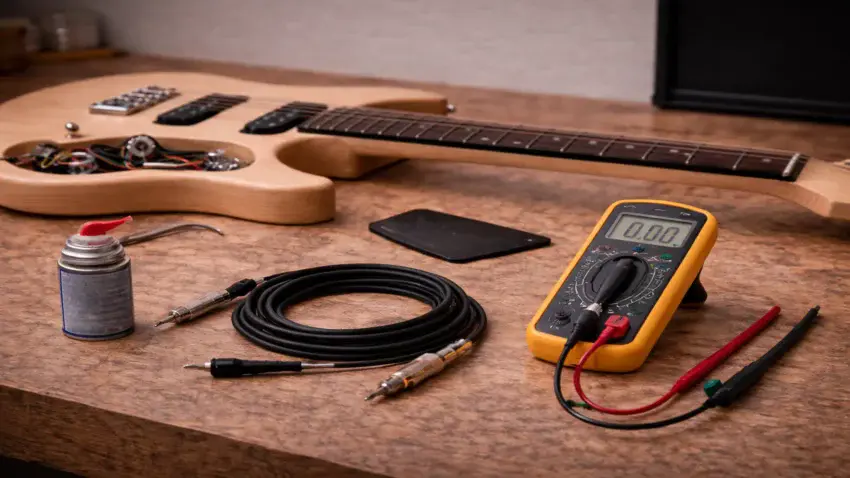
Even when wiring looks correct, problems can still show up once a guitar is fully assembled.
Weak output, crackling noise, intermittent signal loss, or unexpected hum usually aren’t caused
by bad pickups — they’re caused by something that needs to be tested.
That’s where troubleshooting and testing tools come in.
This guide focuses specifically on
troubleshooting and testing tools used during electric guitar kit builds,
what each tool helps diagnose, and when testing fits into the wiring and electronics workflow.
For a broader view of wiring and electronics as a system, start with the main guide:
Electronics and Wiring Tools for Electric Guitar Kits.
Why Testing Matters Before You Close the Guitar
Most electronic problems are easier to fix before the control cavity is closed.
Testing tools help you:
-
Confirm connections are solid
-
Verify signal paths
-
Catch wiring mistakes early
-
Avoid opening the guitar multiple times
Skipping testing often means chasing problems after strings are on and hardware is tightened —
when fixes are slower and riskier.
Common Troubleshooting & Testing Tools You’ll Use
Multimeter
A multimeter is the most important diagnostic tool for guitar electronics.
It’s used to:
-
Check continuity
-
Measure resistance
-
Verify grounds
-
Identify broken connections
You don’t need advanced features —
basic continuity and resistance modes cover most guitar wiring needs.
Audio Probe
An audio probe lets you hear the signal path directly.
It’s useful for:
-
Tracking where signal is lost
-
Verifying pickup output
-
Checking switches and pots
This is especially helpful when wiring looks correct
but sound isn’t behaving as expected.
Test Cable or Known-Good Patch Cable
Sometimes the problem isn’t inside the guitar.
Test cables are used to:
-
Rule out bad instrument cables
-
Confirm output jack connections
-
Isolate signal issues
Always eliminate the simple possibilities first.
Temporary Output Jack or Test Rig
Testing before final installation saves time.
Temporary jacks are used to:
-
Test wiring outside the body
-
Verify function before mounting
-
Reduce rework
This keeps troubleshooting controlled and accessible.
Contact Cleaner (for Diagnostics)
While not a test tool, contact cleaner helps confirm problems.
It’s commonly used to:
-
Identify dirty pots or switches
-
Restore noisy connections
-
Rule out oxidation issues
If noise disappears after cleaning, you’ve found the cause.
When Troubleshooting Happens in the Build
Testing typically happens:
-
After wiring and routing are complete
-
Before closing cavities
-
After final assembly if issues appear
Testing is not a one-time step — it’s a checkpoint.
Testing vs Wiring vs Soldering
Soldering tools make connections.
Wiring tools organize and protect connections.
Testing tools verify connections work as intended.
Understanding this separation keeps troubleshooting focused instead of random.
Before sealing everything up, stepping back to the troubleshooting and testing tools
helps confirm the electronics are working as intended.
Final Thoughts…
Most wiring problems aren’t mysterious — they’re just untested.
When you test methodically and verify each part of the signal path,
guitar electronics become predictable instead of frustrating.
Troubleshooting tools don’t replace good wiring — they confirm it.
If something sounds wrong, don’t guess. Test it.
Ready to Start Adjusting Your Tone?
Check out our other guides:
 If you’re new to guitar kits:
Start with Step-by-Step Guide To Building Your First Electric Guitar Kit and Essential Tools Every Electric Guitar Kit Builder Should Have.
If you already own a kit guitar:
Jump into How To Properly Set Up Your Electric Guitar Kit For Intonation or Fixing Common Problems: Buzzing And Dead Frets.
If you’re chasing better tone:
Head to Understanding Humbucker Vs Single Coil Pickups In Kits or Playing With Tone Controls: Tips For Electric Guitar Kits and start experimenting.
Your Guitar, Your Build, Your Sound
You don’t need a custom shop or a tech on speed dial.
All you need is a little guidance, some patience, and a place to go that shows you what to do next.
Come on man… You got this.
GuitarCrafts is here to help you along the way.
 Craft it. Play it. Own it!
Ready to take your guitar passion beyond the workbench?
See how I built GuitarCrafts.com using the training at Wealthy Affiliate — you can do the same.
Build Your First Website With Wealthy Affiliate (Free)
