
How a guitar is used — clean, driven, or somewhere in between — plays a major role in pickup choice.
For builders working with electric guitar kits, confusion often comes from trying to match pickups to tone descriptions instead of actual playing situations.
This page explains how clean and driven playing use cases influence pickup choice, without diving into tone mechanics, noise behavior, or genre-specific recommendations.
🎸 The real question isn’t clean vs distortion — it’s how you use your guitar most of the time.
🎯 Why How You Play Matters More Than Labels
Terms like “clean” and “distorted” describe how a signal is treated, not how a guitar is played.
Two players may both use clean tones but expect very different responses from their instruments.
Thinking in terms of use case — how often gain is applied, how dynamic the playing is, and how exposed the sound will be — leads to clearer pickup decisions.
✨ If You Play Mostly Clean
Clean playing often places more emphasis on note separation, dynamic response, and how clearly subtle changes are heard.
In clean contexts, players often expect the guitar to respond directly to picking strength and playing nuance.
The pickup choice affects how clearly those details come through during normal use.
✨ If you rely on clean tone, clarity matters more than power.
🔥 If You Use
Overdrive or Distortion
Driven playing introduces compression and saturation into the signal.
In these contexts, players often prioritize consistency, sustain, and how well the sound holds together when pushed.
Pickup choice influences how predictable and controlled the guitar feels when gain is applied regularly.
🔥 If you use gain, thickness and sustain matter more than note separation.
⚖️ If You Play Both Clean and Driven
Many guitars are used for both clean and driven playing.
In these cases, pickup choice often involves balancing clarity with consistency rather than optimizing for a single extreme.
Understanding how the guitar will be used most often helps guide decisions without overthinking tone descriptions.
🎯 The Decision (Simplified)
At a high level:
-
Clean use cases emphasize responsiveness and detail
-
Driven use cases emphasize consistency and control
Start with your main playing style — and the right pickup becomes obvious.
👉 Understanding best pickup type by music style also requires considering how often the guitar will be played clean versus driven.
🎸 This is where clean vs driven
actually changes your choice.
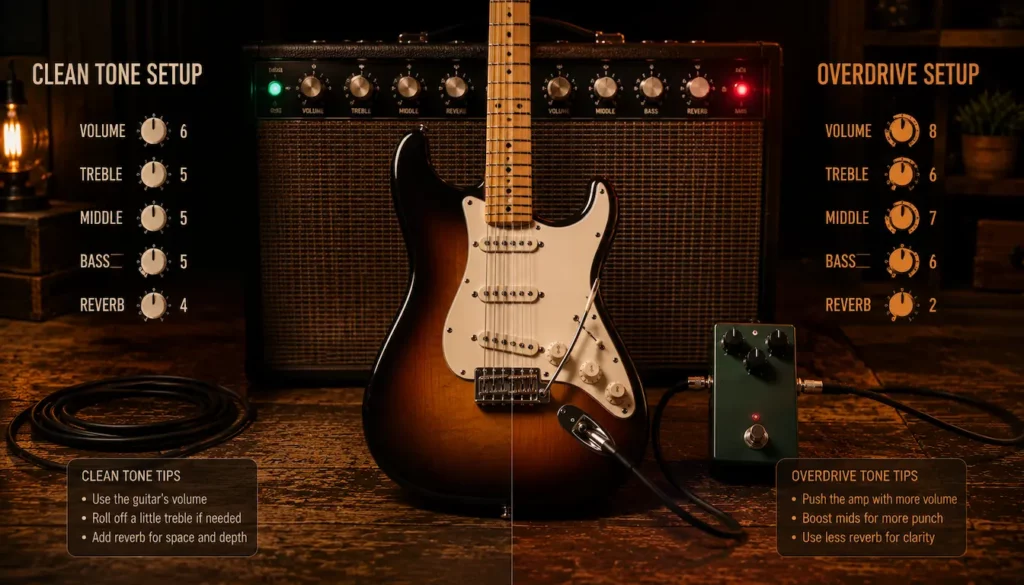
🏁 Final Thoughts…
Clean and driven playing contexts place different demands on a guitar.
By focusing on how the instrument will actually be used, builders can make pickup choices that feel appropriate in real playing situations.
This page exists to clarify clean versus driven use cases — nothing more.
Once you match pickups to how you actually play, everything starts to feel right.
 Ready to Start?
Here’s your next step —
pick one and go:
 New to guitar kits?
Start with
Step-by-Step Guide To Building
Your First Electric Guitar Kit
and
Essential Tools Every Electric Guitar Kit
Builder Should Have.
Already built a kit?
Jump into
How To Properly Set Up Your
Electric Guitar Kit For Intonation
or
Fixing Common Problems:
Buzzing And Dead Frets.
Chasing better tone?
Head to
Understanding Humbucker
Vs Single Coil Pickups In Kits
or
Playing With Tone Controls:
Tips For Electric Guitar Kits
and start experimenting.
 Your Guitar, Your Build,
Your Sound
You don’t need a custom shop or a tech on speed dial.
All you need is a little guidance, some patience,
and a place to go that shows you what to do next.
Come on man… You got this.
GuitarCrafts
is here to help you along the way.
Craft it. Play it. Own it!