
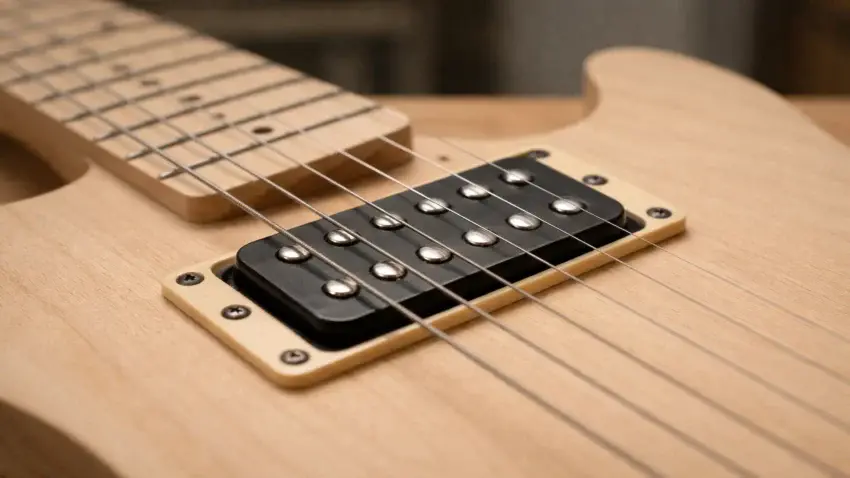
Pickups look simple…
but they’re the reason two guitars
can sound completely different.
⚡ Pickups don’t create tone —
they shape how your guitar is heard.
The good news?
You don’t need to understand electronics
to understand pickups.
This guide breaks it down in plain English
so you can actually make sense of your tone.
⚡ Quick Answer
(Beginner Friendly)
Pickups turn string vibration
into a signal your amp can use.
Different pickups shape that signal —
which is why guitars can sound
warm, bright, aggressive, or smooth.
🎯 Same guitar. Different pickup
= completely different sound.
🔍 What a Guitar
Pickup Actually Does
When you pluck a string, it vibrates.
A pickup sits under the strings and
detects that movement —
not the sound,
just the vibration.
Here’s what happens:
- The string vibrates
- The pickup senses it
- A small electrical signal is created
- That signal goes to your amp
- Your amp turns it into sound
🔊 No pickup = no signal.
No signal = no sound.
🧲 The Basic Parts
of a Pickup
You don’t need schematics
— just the basics:
- Magnets → interact with the strings
- Coil wire → creates the signal
- Housing → holds everything together
These affect:
- Output (how strong the signal is)
- Clarity (how clean notes sound)
- Noise (how much interference you get)
- Feel (how responsive it is)
⚖️ This is why two pickups that look
the same can sound completely different.
🔊 Why Pickups
Sound Different
Pickups don’t add tone
— they shape it.
Some pickups:
- Boost certain frequencies
- React differently to picking
- Handle distortion better
- Reduce noise more effectively
That’s why players
say things like:
- Warm
- Bright
- Clear
- Aggressive
🎧 Those words describe how
your signal behaves — not magic.
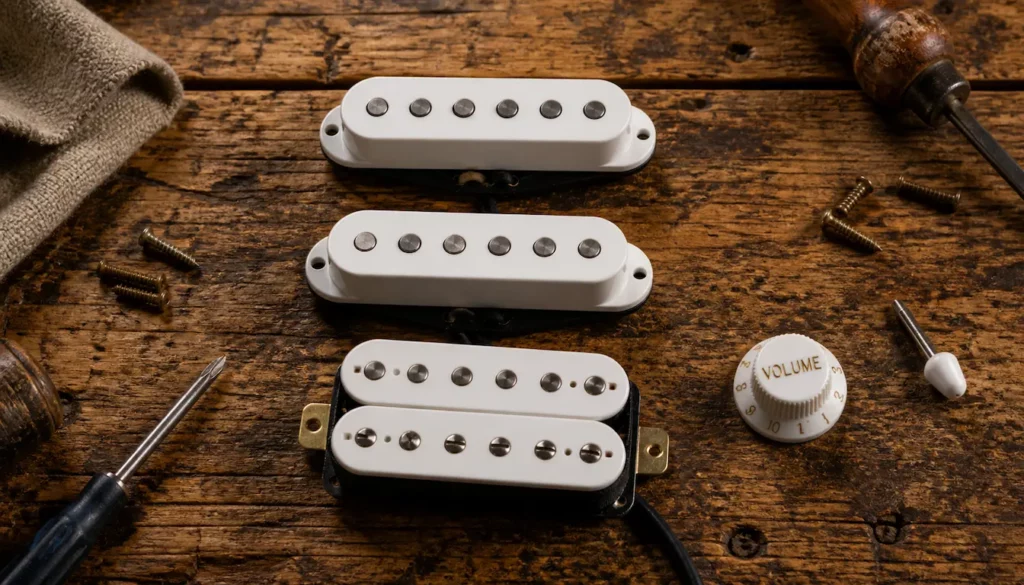
🎯 Why Pickups Matter
More in Electric Guitar Kits
Pickups have a bigger impact in
guitar kits than most beginners expect.
⚡ In a kit build, pickups aren’t just
part of the sound — they define it.
That’s because:
- Stock parts are chosen to keep costs down
- The guitar hasn’t been dialed in yet
- You’re building everything from the ground up
🎸 What This Means for You
Building a kit puts you in control
of your tone from day one.
You can:
✔ Hear the difference pickups actually make
✔ Learn how small adjustments affect your sound
✔ Upgrade later without replacing the whole guitar
🚀 Understanding pickups turns
guesswork into confidence.
🎯 Where Beginners
Should Start
Start with understanding
— not upgrading.
Once you know:
- What pickups actually do
- Why they sound different
- How they affect your tone
…everything else starts to make sense.
🚀 Clarity first. Upgrades later.
👉 If you want a complete beginner-friendly
overview of pickup types and how they’re
used in guitar kits, this guide on
understanding electric guitar pickups in kits
explains everything step by step.
🔥 Final Thoughts…
Pickups aren’t complicated —
they’re just unfamiliar at first.
You don’t need specs or
brand knowledge to understand them.
You just need to understand what they do.
Once that clicks,
every upgrade decision gets easier.
 Ready to Start?
Here’s your next step —
pick one and go:
 New to guitar kits?
Start with
Step-by-Step Guide To Building
Your First Electric Guitar Kit
and
Essential Tools Every Electric Guitar Kit
Builder Should Have.
Already built a kit?
Jump into
How To Properly Set Up Your
Electric Guitar Kit For Intonation
or
Fixing Common Problems:
Buzzing And Dead Frets.
Chasing better tone?
Head to
Understanding Humbucker
Vs Single Coil Pickups In Kits
or
Playing With Tone Controls:
Tips For Electric Guitar Kits
and start experimenting.
 Your Guitar, Your Build,
Your Sound
You don’t need a custom shop or a tech on speed dial.
All you need is a little guidance, some patience,
and a place to go that shows you what to do next.
Come on man… You got this.
GuitarCrafts
is here to help you along the way.
Craft it. Play it. Own it!